Commercial landscape and sports turf irrigation design represents a rigorous discipline of applied hydraulics, requiring precise geometric planning, pressure regulation, and micro-climate zoning. Unlike broadacre agricultural fields where uniform circular or rectangular coverage is standard, commercial landscapes feature complex non-geometric perimeters, steep slopes, shaded understories, high pedestrian traffic, and diverse plant species with divergent water demands. Achieving pristine aesthetic turf quality while meeting strict municipal water conservation mandates requires landscape architects to implement head-to-head coverage, matched precipitation rates, and computerized smart control systems.
The hallmark of an amateur irrigation installation is the presence of brown, desiccated turf patches adjacent to waterlogged, swampy depressions. These glaring performance deficiencies trace directly to hydraulic design errors: mixing spray nozzles with gear-driven rotors on shared control valves, failing to calculate pipe friction losses, or spacing sprinkler heads beyond their engineered throw radius. This comprehensive engineering guide details the mathematical calculations, hydraulic zoning principles, backflow prevention mandates, and smart control technologies essential for high-performance commercial landscape irrigation systems.
The Matched Precipitation Rate (MPR) Axiom
Never mix sprinkler heads with different precipitation rates within the same irrigation zone. Gear-driven rotors typically apply 12 to 18 mm of water per hour, whereas pop-up spray nozzles apply 35 to 45 mm per hour. Operating both technologies on a single control valve guarantees that the rotor area will suffer severe drought while the spray area is drowned in excess runoff.
Hydraulic Foundations: Head-to-Head Geometry and Coverage Patterns
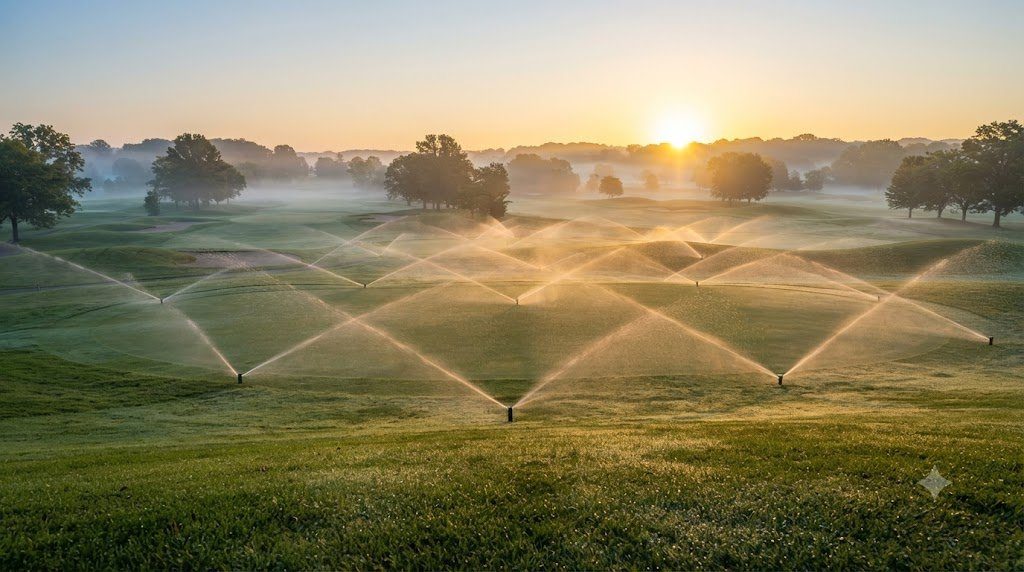
The fundamental geometry of landscape sprinkler layout is built upon head-to-head coverage. Sprinkler heads project water in a wedge-shaped profile where precipitation depth is highest near the nozzle and tapers off toward the outer edge. To achieve a flat, uniform composite water depth across the lawn surface, every sprinkler must throw water all the way to the adjacent sprinkler head.
Agricultural and landscape designers employ two primary geometric layout patterns:
- Square Spacing Layout: Sprinklers are arranged in a square grid where spacing between heads (S) equals spacing between lateral rows (L). Square spacing provides clean alignment for rectangular sports fields and commercial street medians. However, it is vulnerable to wind distortion across diagonal centers. Maximum allowable spacing is 50% of the rated wetted diameter under calm conditions.
- Equilateral Triangular Spacing: Sprinklers are offset on alternating rows such that every head forms an equilateral triangle with its neighbors. Triangular spacing provides superior distribution uniformity and aerodynamic wind resistance across large open turf parks. Row spacing is calculated by: L = S × 0.866.
Matched Precipitation Rate (MPR) Nozzle Engineering
To maintain uniform application depth across a hydrozone containing full-circle (360°), half-circle (180°), and quarter-circle (90°) sprinkler heads, nozzle flow rates must be strictly proportional to arc angle. A quarter-circle head irrigates one-fourth the area of a full-circle head; therefore, its nozzle must discharge exactly one-fourth the flow rate:
Example at 30 psi (2.1 bar):
• 90° Corner Head: 0.25 m³/hr (1.1 GPM)
• 180° Border Head: 0.50 m³/hr (2.2 GPM)
• 360° Interior Head: 1.00 m³/hr (4.4 GPM)
Modern landscape rotor families feature dedicated MPR nozzle racks. If an installer inserts identical nozzles into both a 90° corner head and a 360° center head, the corner head will apply four times more water per square meter than the center head, transforming the corner into a swamp while leaving the center turf dry and stressed.
Hydraulic Sizing: Friction Loss and Velocity Constraints
Designing the underground pipe network requires calculating dynamic pressure losses from the municipal water meter to the hydraulically most remote sprinkler head. Two fundamental hydraulic rules govern commercial landscape piping:
1. The 1.5 m/s (5 ft/s) Velocity Rule
Fluid velocity inside PVC or polyethylene lateral and mainline piping must never exceed 1.5 meters per second (5.0 feet per second). Flowing water possesses momentum; when an electric solenoid valve snaps shut in fractions of a second, high-velocity water slams against the closed valve gate, generating severe water hammer pressure spikes (Joukowsky surge pressures) exceeding 20 bar. These hydraulic shock waves shatter PVC fittings, strip solenoid threads, and rupture underground pipes.
2. Total Dynamic Head Loss Budgeting
Before drafting zone layouts, designers must establish the static water pressure and calculate the total available dynamic pressure budget. Total friction loss across the meter, backflow preventer, mainline, zone valve, lateral pipe, and elevation changes must not exceed available static pressure minus the sprinkler’s design operating pressure:
P_available_loss = P_static – P_sprinkler_design – P_backflow – P_elevation
Pressure Regulator Advantage
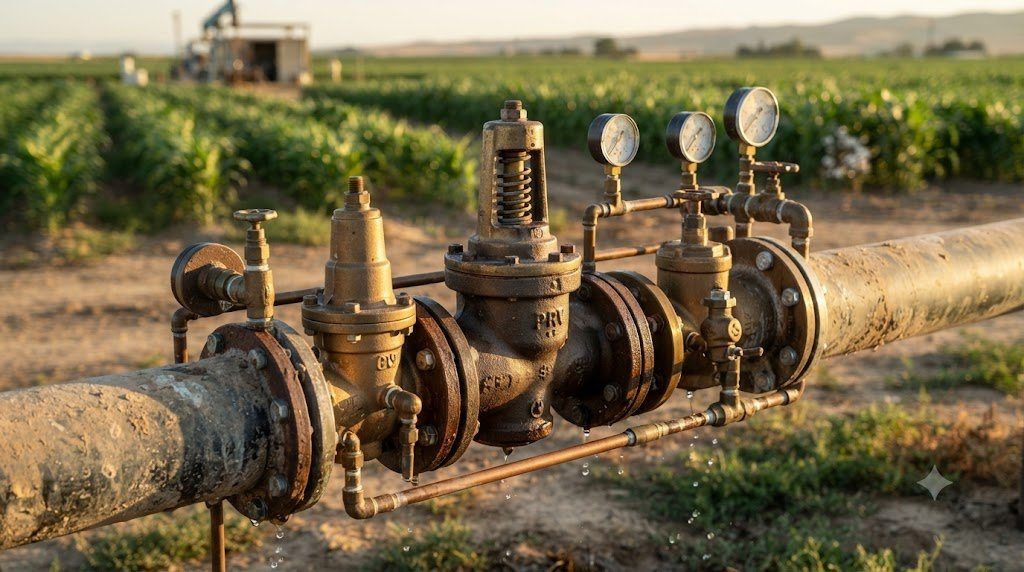
Commercial landscapes frequently experience high municipal mainline pressures (70 to 100 psi). Operating pop-up spray heads at 80 psi causes severe misting and atomization, losing over 50% of water to wind drift. Installing pressure-regulating stems (PRS) built directly into sprinkler bodies locks nozzle pressure to 30 psi (for sprays) or 45 psi (for rotators), saving up to 40% in water use.
Hydrozoning Principles: Micro-Climates and Plant Soil Moisture Grouping
Commercial landscape properties encompass diverse micro-climates that demand isolated hydraulic control zones (hydrozones). Grouping plants according to water requirements and environmental exposure is mandatory for resource conservation:
- Sun vs Shade Exposure: Turf located on the south side of commercial buildings in full sun transpires twice as much water as identical turf shaded on the northern facade. Sun and shade turf must always be separated onto independent control valves.
- Topographical Slope Zones: Slopes shed water rapidly due to gravitational runoff. Slopes must be placed on dedicated zones programmed with ‘Cycle and Soak’ schedules—running sprinklers for 4 minutes, allowing 20 minutes for water to soak in, then repeating the cycle three times to achieve deep root penetration without runoff.
- Plant Horticultural Categories: Turfgrass requires shallow, frequent irrigation; deep-rooted woody shrubs and native trees require infrequent, deep soaking. Combining turf and shrub beds onto a shared valve causes either over-watered root rot in shrubs or drought stress in turf.
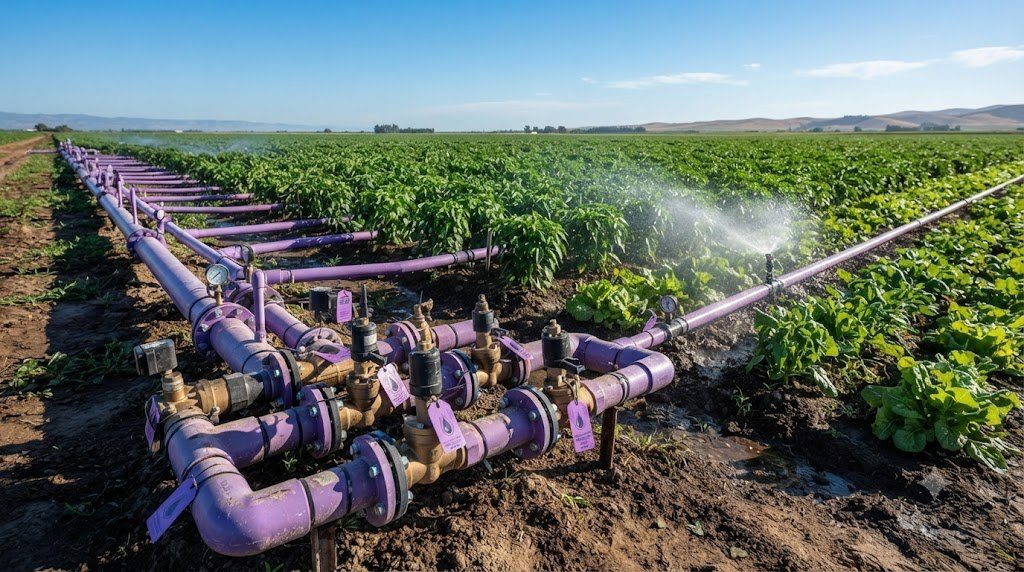
Backflow Prevention Mandates and Cross-Connection Control
Because landscape irrigation systems utilize underground piping in direct contact with fertilizers, animal feces, pesticides, and stagnant soil water, plumbing codes legally mandate certified backflow prevention hardware on all potable connections:
Smart IoT Controllers and Weather-Based Evapotranspiration (ET) Systems
Modern commercial landscapes have transitioned from mechanical clock timers to intelligent IoT weather-based controllers (smart ET controllers). Smart controllers connect via cellular or Wi-Fi networks to local meteorological stations, calculating daily reference evapotranspiration (ETo) based on solar radiation, air temperature, relative humidity, and wind speed.
By pairing daily ETo with crop coefficients (Kc) and rain sensor inputs, smart controllers automatically adjust zone run times daily. When a thunderstorm delivers 15 mm of rain, the controller suspends irrigation cycles across all zones until soil moisture levels deplete. Commercial properties adopting smart ET controllers consistently reduce irrigation water consumption by 25% to 45% while virtually eliminating turf fungus outbreaks associated with over-watering.
Frequently Asked Questions on Commercial Turf Sprinkler Design
Q: What causes landscape spray heads to mist and create fine fog during operation?
Misting occurs when operating pressure significantly exceeds the sprinkler nozzle’s design rating (typically 30 psi for spray nozzles). High pressure atomizes water into microscopic droplets that drift away on the slightest breeze. Installing pressure-regulating sprinkler bodies (PRS-30) or an inline pressure regulator eliminates misting instantly, restoring large, wind-resistant droplets.
Q: What is ‘Cycle and Soak’ programming, and when should it be used?
Cycle and Soak is an advanced controller programming feature that divides total daily zone run times into several short cycles separated by rest periods (e.g., three 4-minute cycles spaced 30 minutes apart instead of one continuous 12-minute run). It is essential for compacted soils, clay profiles, and sloped landscapes where water application rate exceeds soil infiltration rate.
Q: Why do commercial landscape rotors fail to pop up or retract fully?
Failure to pop up is typically caused by insufficient system pressure, undersized lateral piping, or leaks. Failure to retract is caused by sand and grit becoming wedged between the wiper seal and the pop-up riser stem. Installing sprinklers with co-molded heavy-duty polyurethane wiper seals and pressure-activated flushing actions resolves retraction issues.
Q: What is the difference between a master valve and a standard zone valve?
A zone valve controls water flow to a single group of sprinklers in one specific area. A master valve is an electric valve installed at the supply mainline point of connection that opens only when the controller triggers an active zone. If a mainline pipe ruptures or a zone valve sticks open, the master valve prevents catastrophic continuous flooding.
Q: How do landscape check valves prevent low-head drainage?
When an irrigation zone shuts off, water residing in elevated lateral pipes flows down to the lowest sprinkler head and drains out, creating puddles on sidewalks and eroding soil. Built-in check valves (SAM check valves) seal the sprinkler base whenever internal line pressure drops below 10 psi, holding water in the pipe and preventing low-head drainage.
Q: Can rotary multi-stream nozzles replace standard fixed spray nozzles on existing zones?
Yes, rotary nozzles (such as MP Rotators) are designed as direct retrofits for existing spray bodies. Because rotary nozzles apply water at a much lower rate (10 to 15 mm/hr) and require less flow per head, retrofitting can eliminate pressure deficits on struggling zones and reduce run-off on heavy soils.
Closed-Loop Mainline Hydraulics and Pipe Grid Sizing
In large-scale commercial athletic complexes, golf courses, and municipal parks, tree-branched piping layouts often result in severe dynamic pressure imbalances between proximal and distal zones. High-performance landscape engineering resolves this by implementing closed-loop hydraulic mainlines.
A looped mainline routes water along a continuous perimeter ring, feeding submain manifolds from two simultaneous directions. This dual-path flow effectively cuts fluid flow rates within any individual pipe segment in half, reducing dynamic friction head loss by up to seventy-five percent according to the Hazen-Williams relationship (where head loss scales with flow raised to the 1.852 power). Looping stabilizes operating pressures across sprawling properties and prevents pressure drops when multiple high-flow athletic field zones operate simultaneously.
In addition to hydraulic looping, commercial irrigation systems on large corporate campuses benefit significantly from master flow sensing technology. Installing inline impeller or electromagnetic flow sensors connected directly to the central smart controller enables real-time high-flow alarms. If a lawnmower strikes a sprinkler head or a lateral line ruptures, the system detects the abnormal flow surge within thirty seconds, automatically shutting the master valve and sending push notifications to maintenance crews.