Overhead sprinkler irrigation spans a wide spectrum of fluid mechanical technologies, ranging from massive brass impact sprinklers throwing water across forty-meter radiuses to precision engineered micro-rotators providing targeted under-canopy micro-sprays. In orchard management, viticulture, nursery production, and pasture management, selecting the appropriate sprinkler emission mechanism dictates not only overall water application efficiency but also energy consumption, disease susceptibility, and soil structure preservation. Choosing between classic impact technology and modern continuous-rotation micro-devices requires understanding droplet kinetics, trajectory angles, and ballistic fluid mechanics.
For over a century, the spring-loaded brass impact sprinkler dominated commercial irrigation due to its rugged mechanical simplicity and ability to operate on gritty, un-filtered surface water. However, the aggressive kinetic impact of large water droplets on bare agricultural soils causes surface aggregate breakdown, leading to severe crusting and reduced infiltration rates. Modern silicone-damped micro-rotators offer a gentler, highly uniform alternative that preserves delicate soil structures while drastically reducing evaporation losses. This comprehensive guide evaluates the fluid dynamics, droplet physics, wind drift susceptibility, and operational economics of impact sprinklers versus micro-rotators.
The Droplet Kinetic Energy Principle
Water droplet kinetic energy is proportional to the mass of the droplet and the square of its terminal velocity: KE = 0.5 × m × v². Impact sprinklers generate large droplets (3.0 to 5.0 mm diameter) that impact bare soil with sufficient energy to shatter soil aggregates, seal surface pores, and induce immediate runoff. Micro-rotators generate smaller, uniform droplets (0.8 to 1.5 mm diameter) that infiltrate gently without causing soil crusting.
Mechanical Engineering: Spring-Loaded Impacts vs Viscous-Damped Rotators
The mechanical operating principles governing impact sprinklers and micro-rotators represent completely divergent engineering approaches to fluid energy dissipation and stream distribution.
The Classical Spring-Loaded Impact Sprinkler
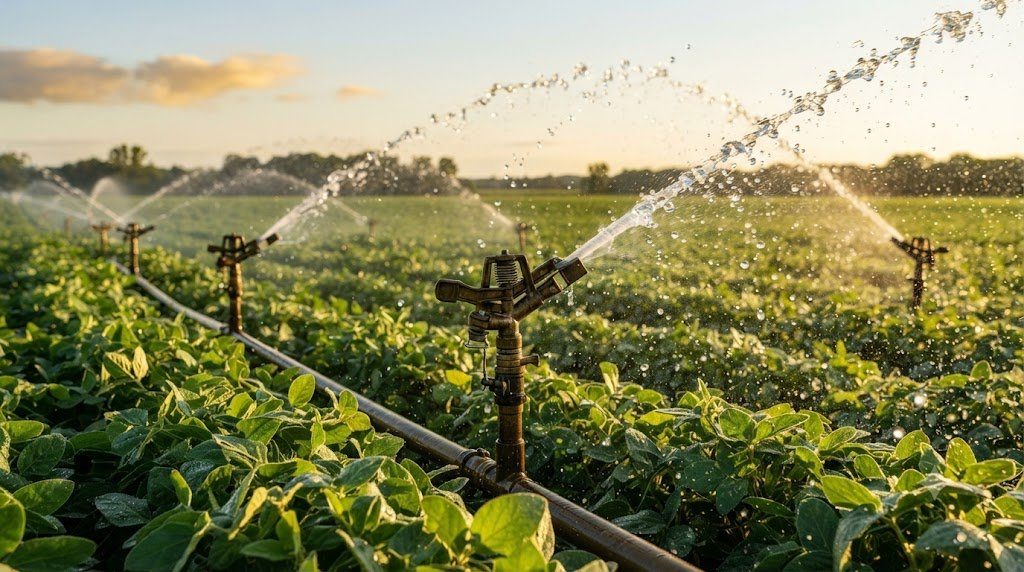
Invented in 1932 by Orton Englehardt, the horizontal-action impact sprinkler utilizes an oscillating spring-loaded drive arm equipped with a spoon deflector. As water discharges from the main nozzle orifice, the high-velocity jet strikes the drive arm spoon, deflecting the arm outward against the tension of a torsional stainless steel spring. When the spring pulls the arm back, the arm strikes the sprinkler body with a sharp mechanical impact, rotating the sprinkler assembly by one to two degrees before the cycle repeats. This continuous hammering motion produces the iconic rhythmic clicking sound of agricultural fields while rotating the nozzle through a full circle or adjustable part-circle arc.
Viscous Silicone-Damped Micro-Rotators
Micro-rotators eliminate mechanical springs and metal-to-metal hammering entirely. Water discharges through a stationary micro-orifice, striking an engineered curved rotor plate. The reaction force of the spinning water jets drives the rotor plate into continuous rotation. To prevent the rotor from spinning out of control at extreme RPMs—which would atomize water droplets into wind-drift prone mist—the rotor shaft is encased in a sealed chamber filled with high-viscosity silicone fluid. This viscous shear damping maintains a smooth, constant rotational velocity (typically 30 to 60 RPM), projecting coherent streams across uniform radial distances without mechanical vibration.
Droplet Dynamics, Trajectory Physics, and Wind Drift Losses
The ballistic flight trajectory of water expelled from a nozzle is governed by projectile physics, aerodynamic drag, and atmospheric evaporative demand. The trajectory angle—the angle between the horizontal ground plane and the nozzle discharge axis—determines both throw distance and wind vulnerability:
1. Standard Trajectory Angles (23° to 27°)
Standard agricultural impact sprinklers utilize trajectory angles between 23 and 27 degrees to maximize throw radius under calm atmospheric conditions. This high trajectory lofts droplets 4 to 8 meters into the air. While maximizing wetted diameter, this prolonged atmospheric residence time exposes droplets to intense solar radiation and horizontal wind vectors. When wind speeds exceed 15 km/h, droplets are carried far off-target, creating dry spots upwind and waterlogged conditions downwind, with evaporative losses often exceeding 25%.
2. Low-Angle Trajectory Regimes (7° to 15°)
In permanent orchards, wind-swept pastures, and under-canopy vineyard blocks, agricultural designers specify low-angle sprinklers (7 to 15 degrees). Micro-rotators commonly utilize low-angle flat trajectories that stay beneath the tree canopy. By keeping droplet flight paths below tree canopies and close to the ground datum, atmospheric residence time is reduced by 70%, effectively neutralizing wind drift and preventing wet foliage that encourages fungal spore proliferation (such as Phytophthora and powdery mildew).
Christiansen Uniformity Coefficient (CU) and Overlap Spacing Criteria
Sprinklers do not deposit water uniformly along their wetted radius; application depth typically tapers from maximum near the head toward zero at the wetted perimeter. Achieving uniform field coverage requires overlapping adjacent sprinkler profiles. Agricultural engineers evaluate overlap performance using the Christiansen Uniformity Coefficient (CU):
CU = 100 × [ 1 – ( ∑ |X_i – X_mean| ) / ( n × X_mean ) ]
Where:
• X_i = Water depth caught in catch can i (mm)
• X_mean = Numerical mean depth across all catch cans (mm)
• n = Total number of catch cans in the audit grid
To maintain a CU above 85%, impact sprinklers require spacing between 50% and 65% of their wetted diameter in square or triangular grid layouts. Micro-rotators, due to their engineered flat-top precipitation profiles, achieve exceptional uniformity (CU > 90%) at spacing intervals between 60% and 75% of wetted diameter, allowing fewer heads per hectare and lowering overall lateral tubing costs.
Head-to-Head Spacing Mandate
Never space sprinklers beyond their rated throw radius. ‘Head-to-head coverage’—where every sprinkler throws water all the way to the base of its adjacent neighbor—is the fundamental baseline for preventing chronic dry zones and stunted crop patches.
Soil Infiltration Kinetics and Surface Crust Prevention
A critical hydraulic parameter frequently ignored in sprinkler system design is the Precipitation Rate (PR) versus soil steady-state Infiltration Rate (IR). The precipitation rate of a sprinkler layout is calculated by the formula:
Where PR is in mm/hr, Q_head is discharge per sprinkler in m³/hr, S_lateral is lateral spacing in meters, and S_sprinkler is spacing along the lateral in meters.
If precipitation rate exceeds soil infiltration rate, water begins to pond on the surface within minutes, creating runoff, erosion furrows, and localized anaerobic soil conditions. In silt and clay loam soils with low infiltration rates (5 to 10 mm/hr), heavy impact sprinklers discharging 15 to 25 mm/hr cause massive runoff. Transitioning to micro-rotators operating at matched precipitation rates of 3 to 6 mm/hr allows the soil matrix to absorb water via capillary infiltration as fast as it is applied, preventing puddling and surface crusting entirely.
Economic Analysis and Energy Lifecycle Costing
While heavy brass impact sprinklers have a lower initial capital cost than micro-rotator systems with integrated pressure regulators, life-cycle economic modeling demonstrates substantial operational cost savings for micro-rotators due to reduced pumping energy:
- Pumping Energy Reduction: Impact sprinklers require 50 to 60 psi (3.5 to 4.2 bar) at the nozzle, demanding higher pump motor horsepower. Micro-rotators operate efficiently at 25 to 30 psi (1.7 to 2.1 bar). Operating at 30 psi lower pump pressure cuts electricity or diesel pumping fuel consumption by 30% to 45% annually.
- Labor and Replacement Costs: Brass impact sprinklers require annual washer replacements and spring tension adjustments. Sealed silicone micro-rotators operate maintenance-free for 7 to 10 years when supported by standard 80-mesh filtration.
- Chemical and Fertilizer Savings: Micro-rotators allow targeted under-canopy fertigation without wetting tree trunks or washing foliar fungicides off fruit crops, saving chemical inputs and preventing collar rot (Phytophthora cactorum).
Comprehensive Field Maintenance and Nozzle Wear Auditing
Over multiple irrigation seasons, suspended sand and mineral grit in irrigation water erode sprinkler nozzle orifices. As an orifice erodes, its cross-sectional area increases, resulting in higher flow discharge and lower operating pressure across the system:
- The Drill Bit Orifice Gauge Test: Technicians should audit sprinkler nozzles annually using precision shank drill bits matching design orifice diameters. If the shank of a drill bit one size larger (1/64-inch over design) slips into the nozzle orifice, the nozzle has eroded by over 10% and must be replaced immediately.
- Bearing Washer Inspection: On impact sprinklers, inspect the PTFE or brass thrust washers located between the bearing sleeve and body. Worn washers increase friction, slowing rotation and causing severe over-watering along stationary drive paths.
- Rotor Plate Inspection: On micro-rotators, inspect rotor grooving for algae growth or mineral scale. Clean fouled rotors by soaking in a 2% citric or phosphoric acid bath.
Frequently Asked Questions on Sprinkler Technology
Q: Why are brass impact sprinklers still preferred in dust-suppression and mining applications?
Brass impact sprinklers feature robust all-metal construction that withstands extreme mechanical abuse, abrasive mining slurry, and freezing conditions that would shatter plastic micro-devices. Their wide discharge orifices (10 to 25 mm) pass large suspended solids without requiring fine secondary filtration.
Q: What causes an impact sprinkler to get stuck in one spot and stop rotating?
Stalling is typically caused by three issues: insufficient operating pressure (below the minimum threshold required to drive the arm), a worn or dirty bearing washer, or a damaged torsional drive spring. Checking pipeline pressure and cleaning the bearing assembly with fresh water usually resolves the issue.
Q: Can micro-rotators be used for orchard frost protection?
Yes, but they must be specifically engineered frost-protection models featuring enclosed drive mechanisms that resist icing. During a freeze, continuous under-canopy or over-canopy water application releases latent heat of fusion (80 calories per gram of water freezing), holding delicate plant buds at 0°C (32°F) even when air temperatures drop to -5°C.
Q: How does water hardness cause micro-rotator failures?
Water containing high concentrations of calcium and magnesium bicarbonates precipitates scale deposits inside the tight tolerances between the spinning rotor and the stationary nozzle body. Applying periodic acid flushes (pH 5.5 to 6.0) through the irrigation lines prevents scale binding and ensures continuous free rotation.
Q: What is the ideal filtration mesh size for micro-rotators?
Most agricultural micro-rotators require filtration between 60 and 80 mesh (250 to 180 microns). While less sensitive to clogging than micro-drip emitters, un-filtered canal debris or coarse sand grains can wedge behind the rotor plate, stalling rotation.
Q: Why should overhead impact sprinklers be avoided on fruit trees during bloom?
Overhead impact sprayers wet flowers and ripening fruit, which washes away protective pollen, inhibits bee pollination, and creates the warm, humid microclimate necessary for fungal pathogens like botrytis blossom rot and apple scab to infect the crop.
Ballistic Trajectory Dynamics and Aerodynamic Drag Forces
The flight physics of an expelled irrigation water droplet is governed by projectile ballistics coupled with nonlinear aerodynamic drag. As a droplet travels away from the nozzle orifice at an initial velocity (V0), it experiences opposing aerodynamic drag proportional to the square of its relative velocity:
F_drag = 0.5 × ρ_air × C_d × A_droplet × V²
Because micro-rotators discharge water across smaller cross-sectional radii at lower initial discharge velocities, droplet shear breakdown is minimized. This prevents the generation of ultra-fine aerosol mist particles (diameters < 0.3 mm) that are immediately vaporized under high vapor pressure deficit (VPD) conditions. Maintaining controlled droplet diameters between 1.0 and 1.8 mm ensures that water droplets retain sufficient mass to reach the target soil zone without atomizing into atmospheric drift.