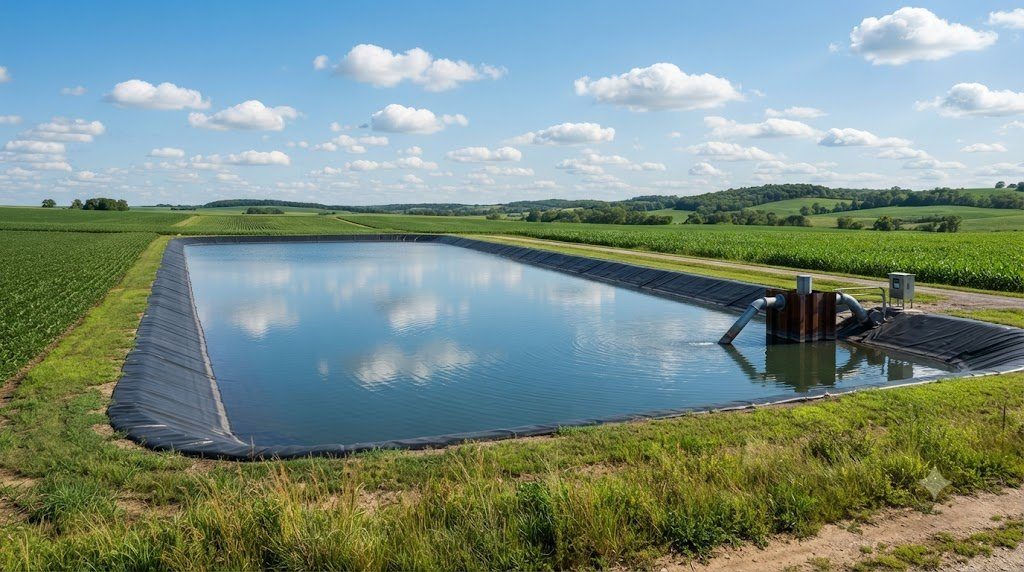
Agricultural rainwater harvesting and on-farm storage catchment basins represent the premier nature-based infrastructure strategy for establishing agricultural water sovereignty and climate resilience. As global groundwater aquifers deplete and statutory surface water rights face stringent curtailments during dry summer months, capturing intense seasonal monsoon or winter rainfall creates an invaluable decentralized water reserve. Harvesting pristine rainwater not only supplies supplemental irrigation during critical crop flowering stages but also provides high-quality, low-salinity water (electrical conductivity < 0.1 dS/m) ideal for blending with saline well water to prevent soil sodicity.
However, engineering a commercial agricultural rainwater harvesting network is far more complex than simply digging an unlined hole in the ground. Un-engineered earth ponds suffer from catastrophic seepage losses exceeding forty percent, rapid sedimentation that chokes storage capacity within years, and structural embankment washouts during 100-year storm events. Developing an enduring rainwater catchment system requires rigorous hydrologic modeling of watershed runoff coefficients, engineered sedimentation pre-basins, geosynthetic pond membrane liners, emergency spillway hydraulics, and specialized floating pump intake stations. This comprehensive technical guide details the civil engineering, membrane physics, water quality preservation, and pumping architectures required for farm-scale rainwater harvesting.
The Runoff Volume Rational Formula
Total harvestable stormwater volume is calculated by the Rational Runoff Equation: V = C × I × A. Where V is volume (m³), C is the dimensionless watershed runoff coefficient (0.85 to 0.95 for metal roofs, 0.20 to 0.40 for vegetated pasture, 0.50 to 0.70 for compacted earth roads), I is rainfall depth (meters), and A is catchment surface area (m²). Sizing reservoirs without measuring true runoff coefficients leads to severe undersizing or spillway failure.
Catchment Hydrology: Rooftop, Engineered Hardstands, and Natural Watersheds
Commercial agricultural properties exploit three distinct catchment surfaces, each characterized by divergent runoff kinetics and water quality profiles:
1. Structural Agricultural Rooftops (Barns, Packing Sheds, Greenhouses)
Galvanized steel barn roofs, commercial packing facilities, and glass greenhouse structures represent the highest-quality catchment surfaces. With an impermeable runoff coefficient (C = 0.90 to 0.95), nearly 95% of all rainfall is immediately converted into high-velocity surface runoff. A single 2,500 square meter packing facility located in a region receiving 600 mm of annual rainfall harvests: 2,500 m² × 0.60 m × 0.92 = 1,380 cubic meters (1.38 million liters) of pristine irrigation water annually. Roof water contains minimal abrasive silt, requiring only basic first-flush diversion before entering storage.
2. Engineered Soil Catchments and Compacted Roadways
Compacted unpaved farm roads, equipment staging yards, and graded hillsides provide expansive catchment footprints (C = 0.50 to 0.70). Roadside swales and v-ditches channel surface runoff toward storage basins. However, runoff from compacted earth carries heavy sediment loads, requiring dedicated sedimentation traps to prevent rapid reservoir silting.
3. Natural Ephemeral Watersheds and Grassland Slopes
Natural vegetative watersheds (C = 0.15 to 0.35) absorb the majority of light rainfall events into soil storage. Surface runoff initiates only after the soil profile reaches saturation during high-intensity, prolonged storm events. Capturing watershed runoff requires contour swales, rock check dams, and broad collection channels designed to handle turbulent flood volumes without eroding.
Earthwork Engineering: Basin Geometry, Compaction, and Seepage Control
Excavating an agricultural storage reservoir requires careful geotechnical engineering. An unlined reservoir excavated in sandy or fractured rock soils will lose up to 50 mm of water depth daily through vertical seepage—completely draining the storage reserve before summer irrigation commences:
1. Compacted Clay Core and Bentonite Liners
In soils containing at least 25% clay content, civil engineers can construct an unlined clay blanket. The soil is excavated, moisturized to optimum Proctor compaction moisture, and rolled in 150 mm lifts using heavy sheepsfoot rollers to achieve a compacted clay blanket at least 300 to 450 mm thick. Alternatively, natural sodium bentonite clay can be incorporated into permeable soils at a rate of 15 to 25 kg/m². When hydrated, bentonite swells to 15 times its dry volume, sealing soil pores and reducing permeability below 1 × 10⁻⁷ cm/s.
2. Geosynthetic Membrane Liners: HDPE, EPDM, and Reinforced Polyethylene
Where impermeable clays are unavailable, geosynthetic membrane liners provide 100% seepage elimination. High-Density Polyethylene (HDPE, 40 to 60 mil thickness) represents the agricultural industry standard, offering exceptional tensile strength, chemical resistance, and UV stabilization for expected lifespans exceeding 25 to 30 years. HDPE sheets are thermal wedge-welded in the field by certified technicians, with all seams pressure-tested using dual-track air channels. Liners are anchored at the basin perimeter in dedicated 500 mm deep anchor trenches backfilled with compacted earth.
The Geotextile Underlayment Mandate
Never lay an HDPE or EPDM liner directly onto rocky native soil. Sharp stones and shale fragments will puncture the membrane under the massive hydrostatic weight of deep water columns. Always lay a 250 to 300 g/m² non-woven polypropylene cushion geotextile underlayment beneath the geomembrane to protect against punctures.
Sedimentation Basins and First-Flush Diversion Architecture
The primary operational failure of farm reservoirs is silt accumulation. Runoff entering a pond directly carries tons of suspended mineral silt and organic detritus. Within 5 to 10 years, sediment accumulation cuts storage volume in half and damages intake pumps. Preventing this requires two-stage sediment separation:
1. The First-Flush Diversion Principle
The initial rainfall of any storm event washes accumulated bird droppings, dust, pollen, and debris off catchment surfaces. An automated first-flush diverter captures and isolates the first 1.0 to 2.0 mm of rainfall into a dedicated offline diversion chamber. Once the first-flush chamber fills, clean subsequent runoff bypasses the diversion and flows into the primary reservoir.
2. Two-Chamber Gravity Sedimentation Pre-Basins
Before stormwater enters the main geomembrane-lined storage reservoir, it must pass through an unlined or concrete-lined forebay sediment basin sized to slow fluid velocity below 0.1 m/s. According to Stokes’ Law of sedimentation, reducing fluid velocity allows heavy sand and silt particles (specific gravity > 2.6) to settle rapidly by gravity. A submerged weir wall allows clean surface water to decant into the main storage reservoir, while captured sediment in the forebay is easily excavated every 3 to 5 years using a standard backhoe without endangering the primary pond liner.
Floating Pump Stations and Bio-Algae Control in Storage Reservoirs
Extracting water from an open agricultural reservoir presents unique hydraulic challenges. Standard bottom-intake pipes suck up anaerobic mud and decaying vegetative sludge, clogging downstream irrigation filters. Modern farm reservoirs deploy floating pontoon intake stations:
- Articulated Floating Pump Skids: The pump suction intake is suspended from heavy-duty rotational-molded polyethylene pontoons, holding the intake screen exactly 0.5 to 1.0 meter beneath the water surface. This extracts the cleanest, warmest, most oxygenated water while staying above bottom sediments and beneath floating surface debris.
- Solar Micro-Aeration and Destratification: Deep reservoirs experience thermal stratification in summer, forming a stagnant, anaerobic bottom hypolimnion layer rich in dissolved iron and hydrogen sulfide. Installing solar-powered bottom fine-bubble diffusers circulates the water column, preventing algae blooms and eliminating foul odors.
- Modular Floating Hexagonal Shade Covers: Open reservoirs lose up to 1.5 to 2.5 meters of water depth annually to summer surface evaporation. Deploying interlocking floating modular shade covers (such as hexagonal plastic shade balls) blocks 95% of solar radiation, cutting evaporation losses by up to 90% while starving algae of the sunlight required for photosynthesis.
Frequently Asked Questions on Farm Rainwater Harvesting
Q: How much water can I harvest from a 1,000 square meter barn roof during a 25 mm rain event?
Using the Rational Runoff formula: Volume = Area × Rainfall × Runoff_Coefficient. Volume = 1,000 m² × 0.025 m × 0.90 = 22.5 cubic meters (22,500 liters or approximately 5,940 gallons) captured from a single 1-inch rainstorm.
Q: What is the difference between HDPE and EPDM pond liners?
HDPE (High-Density Polyethylene) is rigid, highly puncture-resistant, chemically inert, and welded with heat seams; it is the industry standard for large broadacre reservoirs (> 1,000 m²). EPDM (Ethylene Propylene Diene Monomer) is synthetic rubber that offers extreme flexibility and conforms easily to irregular, rocky trenches; it is popular for small-to-medium ponds (< 1,000 m²) and joins with adhesive tape.
Q: How do I prevent mosquitoes from breeding in an agricultural rainwater pond?
Stock the reservoir with native insectivorous fish (such as mosquito fish, Gambusia affinis, or fathead minnows). Additionally, maintaining continuous surface water movement using solar aerators prevents female mosquitoes from depositing eggs on the surface film.
Q: Why must an emergency spillway be engineered for an earth catchment pond?
During extreme 50-year or 100-year storm events, runoff will exceed reservoir storage capacity. If water overtops the earth embankment dam, the cascading water will scour and erode the downstream face, causing catastrophic dam breach and downstream flooding. A broad, rock-armored emergency spillway safely vents excess floodwater around the dam.
Q: Can harvested rainwater be blended with high-salinity well water for drip irrigation?
Yes, harvested rainwater has near-zero electrical conductivity (EC < 0.1 dS/m) and zero dissolved salts. Blending 50% harvested rainwater with brackish well water (EC = 3.0 dS/m) cuts final irrigation salinity in half (EC = 1.5 dS/m), safely unlocking saline aquifers for sensitive horticultural crops.
Q: What permits are legally required to build an agricultural rainwater catchment pond?
Permits vary by jurisdiction. In many US states and international basins, capturing rooftop runoff is exempt from water rights. However, damming a natural seasonal stream or constructing an earth dam exceeding specific heights (typically 1.8 to 3.0 meters) requires state dam safety engineering reviews, environmental permits, and water rights appropriations.
Emergency Spillway Hydraulics and Broad-Crested Weir Physics
The survival of an earthen embankment catchment reservoir during extreme meteorological precipitation events depends on the hydraulic design of its emergency spillway. The emergency spillway acts as a broad-crested weir engineered to vent peak inflow volumes around the earth dam without allowing reservoir water levels to overtop the dam crest:
Where:
• Q_spillway = Maximum discharge capacity (m³/s)
• C_w = Broad-crested weir discharge coefficient (typically 1.60 to 1.70 for trapezoidal earth crests)
• L_crest = Effective horizontal width of the spillway crest (meters)
• H = Total energy head above the spillway crest datum (meters)
The spillway channel must be excavated into undisturbed native ground around the embankment shoulder, never through compacted fill. The exit channel must be armored with heavy rock riprap (D50 rock diameter > 300 mm) or articulated concrete blocks to dissipate kinetic water energy before discharging safely into downstream natural drainage paths, preventing headcut erosion from migrating back toward the reservoir.
Geomembrane Thermal Wedge Welding and Quality Assurance Testing
Ensuring 100% water tightness in large geosynthetic-lined agricultural reservoirs requires rigorous field welding quality assurance. Polyethylene membrane sheets are joined using self-propelled dual-track hot wedge welding machines that melt opposing sheet boundaries under calibrated mechanical roller pressure, creating a continuous dual weld seam separated by an internal air channel:
Technicians seal both ends of the internal air channel and pressurize it to 2.0 bar (30 psi) using a hand air pump and pressure gauge. If the seam holds pressure without dropping more than 0.1 bar over a 5-minute test window, the weld is certified leak-free. Complex extrusion welds around pipe penetrations are inspected using a vacuum box tester coated with soapy surfactant solution, confirming that not a single drop of precious harvested rainwater will escape into subsoil aquifers.