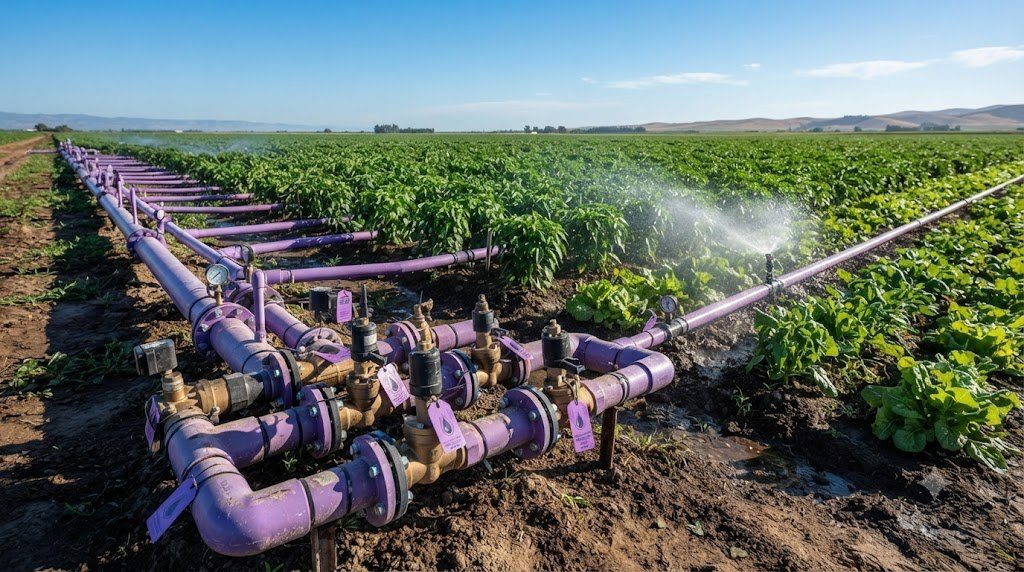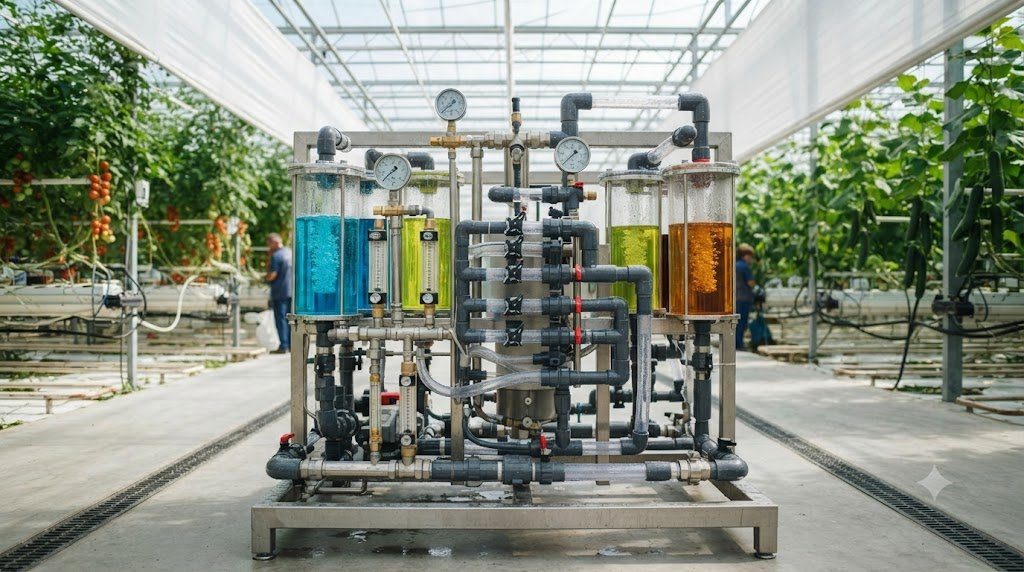
Drip fertigation represents the ultimate convergence of plant nutrition and precision hydraulics, enabling commercial growers to deliver solubilized macro- and micro-nutrients directly into the active root absorption zone at exact physiological growth stages. By synchronizing nutrient delivery with actual daily crop evapotranspiration, fertigation reduces fertilizer consumption by thirty to fifty percent compared to traditional broadcast applications while eliminating nitrogen leaching into groundwater tables. However, injecting highly concentrated chemical compounds into low-pressure micro-irrigation networks requires rigorous technical oversight of injection hardware, chemical compatibility matrices, solution solubility limits, and post-injection system flushing.
Modern commercial agronomy no longer views irrigation and fertilization as disconnected cultural practices. In high-efficiency production systems, water serves as the physical carrier for a continuous, balanced ionic nutrient stream engineered to match dynamic crop demand curves. When executed properly, fertigation maximizes nutrient uptake efficiency, stabilizes root zone electrical conductivity (EC), and prevents osmotic shock. Conversely, improper chemical combinations or careless operational protocols can rapidly destroy expensive emitter infrastructure through catastrophic mineral precipitation.
The Chemical Compatibility Imperative
Never mix calcium-based fertilizers (such as Calcium Nitrate) with phosphates or sulfates (such as Monoammonium Phosphate or Potassium Sulfate) within an identical concentrate stock tank. Doing so triggers instantaneous precipitation of insoluble Calcium Phosphate and Calcium Sulfate (gypsum), permanently clogging thousands of emitter labyrinths throughout the field.
Injection Hardware Engineering: Venturi, Piston Pumps, and Hydraulic Motors
Selecting the appropriate chemical injection mechanism is critical for maintaining dosage precision, system repeatability, and equipment longevity. Agricultural engineers typically specify one of three core injection technologies:
1. Differential Pressure Venturi Injectors
Venturi injectors operate on Bernoulli’s fluid dynamic principle. By routing water through a converging-diverging nozzle, fluid velocity increases dramatically at the throat, causing static pressure to drop below atmospheric pressure. This creates a powerful vacuum that suctions liquid fertilizer into the primary flow stream. Venturis are completely solid-state, feature zero moving mechanical parts, and offer exceptional chemical resistance. However, they require a 20% to 35% pressure differential across inlet and outlet ports, often necessitating a dedicated booster pump or motorized bypass valve.
2. Positive Displacement Motorized Piston and Diaphragm Pumps
Electric positive displacement pumps use reciprocating ceramic pistons or fluoropolymer diaphragms to inject precise chemical volumes directly into high-pressure pipelines regardless of mainline pressure fluctuations. Equipped with digital stroke rate adjusters and 4-20mA telemetry interfaces, these pumps integrate seamlessly with modern SCADA and IoT farm controllers. Their mechanical complexity demands regular valve rebuilds and seal replacements, but their volumetric precision remains unmatched for high-value horticulture.
3. Water-Powered Hydraulic Dosers
Hydraulic proportional dosers operate without external electrical power, driven entirely by the kinetic energy of the irrigation water flowing through an internal piston motor. The doser pulls fertilizer stock solution directly from an unpressurized container in direct proportion to water volume throughput. If line flow fluctuates, the injection rate scales automatically, preserving a uniform chemical concentration across fluctuating flow zones.
Fertilizer Chemistry: Solubility Limits and Compatibility Matrices
Stock solution preparation requires strict adherence to temperature-dependent solubility thresholds. Dissolving dry fertilizers is an endothermic reaction (absorbing thermal energy from water), significantly cooling the solution and reducing saturation limits. Mixing fertilizer batches with cold groundwater during winter or early spring frequently results in un-dissolved crystals settling at tank bottoms, which can quickly bypass primary filters and blind emitter labyrinths.
The Critical ‘Jar Test’ Verification Protocol
Before introducing any new fertilizer formulation or chemical adjuvant into field storage tanks, operators must perform a standardized compatibility jar test. Blend the planned chemical concentrates into a clean glass container holding irrigation source water at the exact proportional field concentrations. Seal the container, agitate thoroughly, and inspect after 1, 6, and 24 hours under low-temperature conditions. If cloudiness, gelatinous flocs, micro-crystallization, or sediment precipitates form, the chemical combination is incompatible and must never be co-injected.
The Dual-Tank ‘A/B’ Standard
Commercial fertigation facilities always construct isolated ‘Tank A’ and ‘Tank B’ storage units. Tank A houses calcium compounds (Calcium Nitrate), potassium nitrate, and chelated micronutrients. Tank B contains phosphate fertilizers (MAP, MKP), sulfate fertilizers (Potassium Sulfate, Magnesium Sulfate), and micronutrient sulfates. Acid injection is maintained in an independent third chamber (Tank C).
Precision Acid Injection for pH Control and Bicarbonate Remediation
Groundwater in many agricultural basins contains elevated concentrations of dissolved calcium and bicarbonate ions (HCO3–). When irrigation water with high bicarbonates warms within surface laterals, carbon dioxide off-gasses, raising the solution pH above 7.8 and triggering the precipitation of insoluble Calcium Carbonate (scale):
Ca2+ + 2HCO3– ↔ CaCO3↓ + H2O + CO2↑
To prevent this scaling, agricultural engineers inject mineral acids (Sulfuric Acid, Phosphoric Acid, or Nitric Acid) to neutralize bicarbonates and maintain an operating delivery pH between 5.8 and 6.2. At this slightly acidic pH, mineral nutrients remain in fully plant-available ionic form, emitter labyrinths remain free of calcification, and root nutrient uptake efficiency reaches its physiological optimum.
Calculating the exact acid dosage requires determining the total alkalinity of the source water via titration. As an engineering baseline, neutralizing 1.0 milliequivalent per liter (meq/L) of bicarbonate alkalinity in 1,000 cubic meters of irrigation water requires approximately 49 kilograms of 100% sulfuric acid or 98 kilograms of 75% phosphoric acid. Automated pH controllers monitoring downstream electrodes continuously modulate chemical injection pumps to prevent over-acidification that could corrode metal pipe fittings.
Calculating Fertilizer Injection Rates and Mathematical Proportions
Precision fertigation requires calculating the exact volumetric injection pump rate (Q_inj) in liters per hour to achieve targeted parts per million (ppm) elemental nutrient concentrations in the mainline water stream:
Where:
• Q_inj = Chemical injection pump discharge rate (Liters per hour)
• Target_ppm = Desired elemental nutrient concentration in field water (mg/L)
• Q_mainline = Irrigation system delivery flow rate (Cubic meters per hour × 1000 = L/hr)
• Stock_Concentration_ppm = Concentration of active element in the fertilizer stock tank (mg/L)
For example, if a grower desires a 150 ppm Nitrogen application across an orchard block operating at 60 cubic meters per hour (60,000 L/hr) using liquid UAN-32 (containing 32% nitrogen by weight with a density of 1.32 kg/L, yielding 422,400 ppm N in neat form):
Q_inj = (150 × 60,000) / 422,400 = 9,000,000 / 422,400 = 21.3 L/hr
The operator sets the injection pump to exactly 21.3 liters per hour during Phase 2 of the fertigation set. This level of mathematical precision prevents excessive nutrient application, saves thousands of dollars in chemical inputs, and ensures uniform vegetative and reproductive growth across large commercial acreage.
The Essential Three-Phase Fertigation Cycle
Never inject fertilizers at the immediate start or end of an irrigation set. Precision fertigation must strictly adhere to the calibrated three-phase operational cycle:
- Phase 1: Pressurization and Hydraulic Stabilization (First 25% of Cycle): The system operates on clean water until operating pressure stabilizes across the most remote lateral runs and all air is expelled through automatic air release valves.
- Phase 2: Chemical Injection Phase (Middle 50% of Cycle): Solubilized nutrients are metered into the mainline at calculated concentrations. Because the hydraulic network is fully pressurized, nutrient distribution across the block matches the system’s design Emission Uniformity.
- Phase 3: Clean Water Post-Flush (Final 25% of Cycle): Chemical injection ceases while water continues to flow through the system. This phase must run long enough to clear all residual fertilizer from mainlines, submains, and laterals. Any nutrient residues left in idle tubing feed bacterial slime and fungal mats, accelerating emitter clogging.
Monitoring Soil Salinity and Electrical Conductivity (EC)
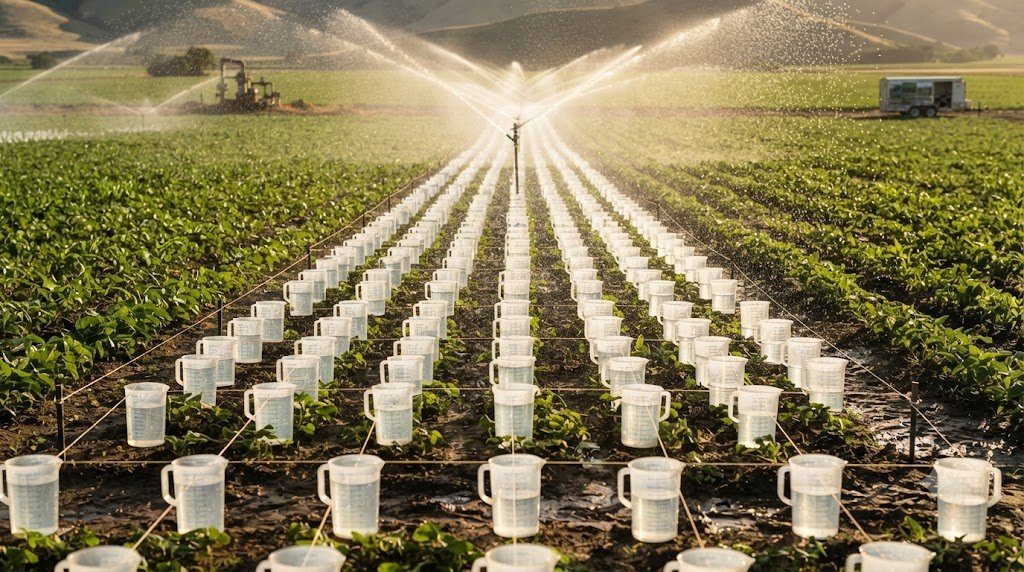
Because fertigation injects mineral salts directly into the root zone, continuous monitoring of electrical conductivity is critical to prevent osmotic stress. Emitter discharge zones naturally accumulate a perimeter ring of concentrated salts along the outer boundary of the wetted bulb. If light rainfall events occur, these concentrated salts can be washed downward directly into the active root zone, causing severe crop leaf scorch and root dieback.
Growers should utilize in-situ electromagnetic soil sensors or perform regular 1:2 soil-to-water extract tests. When soil solution EC exceeds crop-specific salt tolerance thresholds (e.g., 1.5 dS/m for sensitive strawberries, 3.0 dS/m for almonds, 7.0 dS/m for cotton), a dedicated leaching fraction must be calculated. Applying an additional 10% to 20% water volume during pure water irrigation cycles pushes accumulated salts below the root zone into deeper subsoil layers.
Safety Engineering and Environmental Compliance Mandates
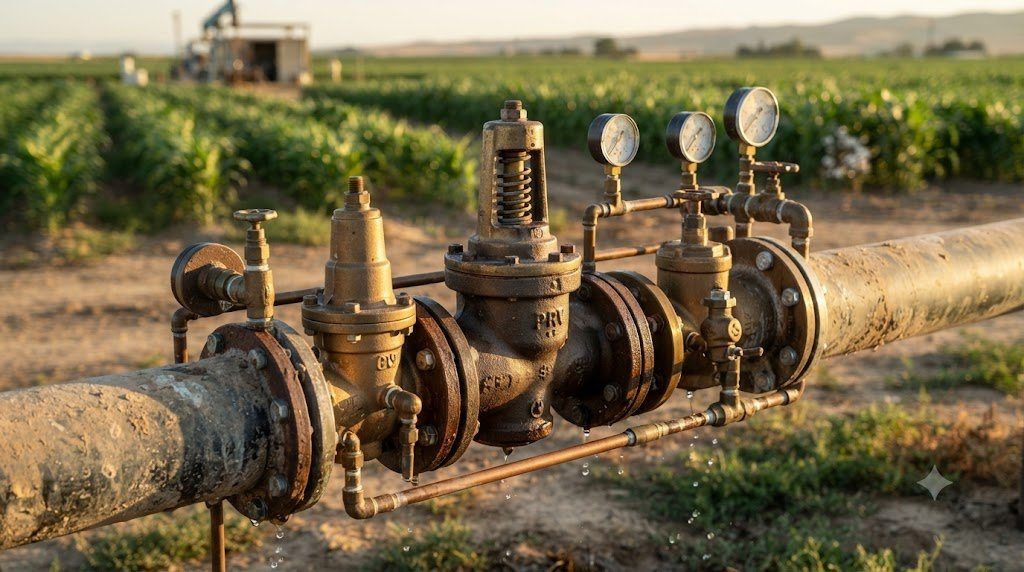
Injecting agricultural chemicals into pressurized water networks creates legal and environmental liabilities regarding groundwater aquifer contamination. Regulations strictly mandate comprehensive backflow prevention infrastructure at all injection sites:
Frequently Asked Questions on Precision Fertigation
Q: How long must the post-fertigation clean water flushing phase run?
The flush cycle must equal or exceed the hydraulic travel time from the injection point to the most distant lateral flush valve, plus a 20% safety margin. In typical 5-hectare orchard blocks, this flushing window ranges from 30 to 45 minutes. Test water electrical conductivity (EC) at the end of the run; flushing is complete when EC matches source water values.
Q: Which acid is best suited for agricultural drip system cleaning?
Sulfuric acid (66° Baume / 93%) is the most cost-effective acid for broadacre bicarbonate remediation. Phosphoric acid (75% to 85%) supplies valuable phosphorus while neutralizing alkalinity, making it popular for permanent crops. Nitric acid (67%) provides supplemental nitrogen and powerful cleaning action but requires specialized handling due to high volatility.
Q: Can organic fertilizers (fish hydrolysate, kelp) be injected through drip systems?
Yes, but with strict precautions. Organic materials contain particulate fibers and suspended colloidal matter. They require specialized disc filtration (at least 150 mesh) and must be injected alongside biological enzyme treatments or hydrogen peroxide to prevent bacterial fermentation within laterals.
Q: What safety backflow prevention hardware is legally required for fertigation?
Under US and international regulations, any chemical injection system connected to a well or municipal source must incorporate a certified Reduced Pressure Zone (RPZ) backflow preventer or double check valve assembly with an automatic low-pressure drain and vacuum breaker to prevent contamination of aquifers.
Q: Can micronutrients (iron, zinc, manganese) be injected alongside standard N-P-K blends?
Yes, provided the micronutrients are in chelated form (such as Fe-EDDHA, Fe-DTPA, or Zn-EDTA). Unchelated inorganic mineral salts (such as iron sulfate) react rapidly with phosphate fertilizers and high-pH water, causing instant precipitation of insoluble metal hydroxides that clog emitters.
Q: How does water pH influence plant nutrient uptake efficiency?
At a water pH above 7.5, phosphorus, iron, zinc, and manganese precipitate into insoluble mineral complexes, rendering them unavailable for plant root absorption. Maintaining irrigation water pH between 5.8 and 6.5 optimizes the solubility and uptake bioavailability of all essential macro- and micro-nutrients.
Seasonal Nutrient Demand Curves and Crop-Specific Uptake Dynamics
Precision fertigation management hinges on aligning nutrient injection curves with the actual physiological phenology of the crop. For example, deciduous fruit and nut orchards exhibit three distinct seasonal demand phases: initial early-spring vegetative flush, mid-summer fruit sizing and kernel fill, and post-harvest root carbohydrate storage.
During early vegetative stages, crops require a higher ratio of nitrate nitrogen to stimulate canopy development. As plants enter reproductive fruit setting, nitrogen applications must be sharply curtailed to avoid excessive vegetative vigor, while potassium (K2O) injection is increased to drive sugar transport, fruit sizing, and rind thickness. Delivering nutrients in small, daily or weekly micro-doses through the drip system eliminates the osmotic spikes and deep leaching losses inherent to broadcast granular applications.
Furthermore, modern commercial fertigation allows growers to implement dynamic proportional electrical conductivity (EC) targeting. Rather than maintaining fixed injection rates throughout the season, automated EC controllers adjust chemical metering in response to ambient temperatures and evaporative demand. On hot, dry afternoons when crop transpiration peaks, the system reduces the nutrient concentration in the water stream to prevent salt accumulation around root tips, delivering dilute hydration when plants need it most.