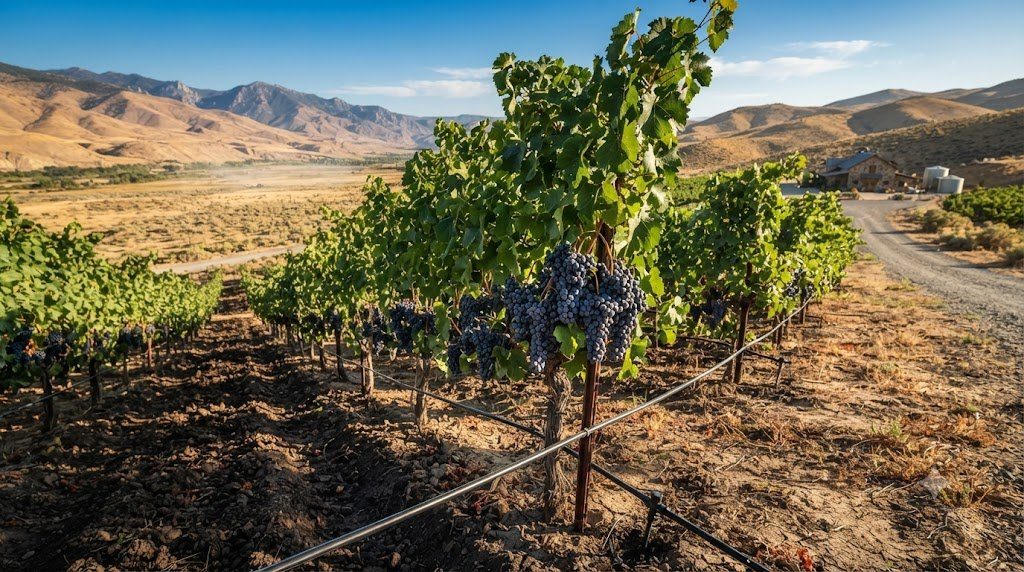
Regulated Deficit Irrigation (RDI) represents one of the most sophisticated and economically impactful water conservation strategies in modern commercial agronomy. For decades, conventional agricultural wisdom dictated that maximizing crop yield required satisfying one hundred percent of crop evapotranspiration (ETc) throughout the entire vegetative and reproductive season. However, rigorous plant physiological research over the past thirty years has disproved this assumption. Plant species exhibit distinct phenological growth stages where vegetative sensitivity to moisture deficits is extremely low, and where imposing controlled, deliberate water stress actually improves crop quality, concentrates premium sugars and polyphenols, and suppresses unnecessary vegetative shoot growth without penalizing harvest yield.
Managing Regulated Deficit Irrigation is an exacting agronomic science that balances on the knife-edge between beneficial physiological stress and catastrophic yield loss. Withholding water during the wrong phenological stage—such as during almond flower bloom or grape berry cell division—triggers irreversible flower abortion, stunted fruit size, and severe economic losses. Executing RDI safely requires transitioning away from soil moisture guesswork to direct, real-time plant physiological stress monitoring using Pressure Chamber Midday Stem Water Potential (Ψstem) and infrared canopy thermometry. This comprehensive engineering guide examines plant water stress physiology, phenological susceptibility matrices, pressure bomb calibration protocols, and commercial RDI management schedules for deciduous orchards and vineyards.
The Core RDI Agronomic Principle
Regulated Deficit Irrigation is the strategic reduction of water applications during specific, drought-tolerant crop phenological growth stages, followed by full water replenishment during sensitive stages. By reducing seasonal water consumption by twenty to forty percent, RDI cuts pumping energy costs, controls excessive canopy vigor, reduces disease pressure, and dramatically enhances fruit quality attributes.
Plant Water Stress Physiology: Stomatal Conductance and Cavitation Resistance
To successfully manage deficit irrigation, agronomists must understand how vascular plants regulate internal moisture under atmospheric demand. Water moves through the soil-plant-atmosphere continuum (SPAC) along a continuous gradient of declining water potential (Ψ):
Water is pulled from soil pores into root xylem, travels up the vascular stem, and evaporates into the atmosphere through microscopic foliar stomata. As soil moisture depletes, root cells synthesize abscisic acid (ABA), a biochemical signaling hormone transported via xylem sap to the canopy. ABA triggers guard cells to deflate, closing stomatal apertures. Stomatal closure reduces transpirational water loss, but also restricts carbon dioxide (CO2) intake, slowing photosynthetic assimilation.
The Hydraulic Safety Margin vs Photosynthetic Tradeoff
The goal of RDI is to induce mild-to-moderate stomatal closure that suppresses vegetative shoot elongation (diverting carbohydrates to developing fruit) while preserving net carbon assimilation. However, if internal plant water tension drops beyond critical thresholds, the tensile water column within the xylem vessels snaps under extreme negative pressure, causing xylem cavitation (embolism). Air bubbles fill the vascular vessels, permanently disabling water transport and causing leaf scorch and branch dieback. Measuring plant water potential daily prevents exceeding xylem safety thresholds.
Precision Instrumentation: The Scholander Pressure Chamber Protocol
Soil moisture sensors measure how much water resides in the ground, but they cannot measure whether the plant is experiencing physiological stress. Root architecture, rootstock vigor, and atmospheric vapor pressure deficit all influence plant hydration. The global scientific standard for measuring true crop water status is the Scholander Pressure Chamber (the ‘Pressure Bomb’):
Midday Stem Water Potential (Ψ_stem) Operating Protocol
- Leaf Selection and Bagging: Between 12:00 PM and 2:00 PM (solar noon), select healthy, mature leaves located deep in the shaded interior of the lower canopy. Seal each selected leaf inside an airtight, reflective foil-laminate bag for at least 90 to 120 minutes prior to excision.
- Xylem Vapor Equilibrium: Shading and bagging halts foliar transpiration, allowing the leaf water potential to equilibrate with the hydrostatic water potential of the primary tree trunk (stem).
- Excision and Chamber Sealing: Cut the leaf petiole with a razor-sharp scalpel, insert the leaf into the pressure chamber, and clamp the rubber gland seal around the protruding petiole tip.
- Nitrogen Pressurization: Slowly pressurize the chamber with compressed nitrogen gas (0.05 MPa per second) while observing the cut petiole cross-section under an illuminated 10X magnifying glass.
- End-Point Balance Pressure: The exact pressure reading on the digital gauge the microsecond water sap bubbles to the cut surface equals the negative hydrostatic tension within the plant xylem (Ψstem in MegaPascals or bars).
The Pressure Chamber Value Interpretation
Stem water potential is expressed as a negative number (e.g., -0.8 MPa = -8.0 bar). More negative numbers designate greater water stress. An almond tree at -0.8 MPa is fully hydrated and unstressed; at -1.4 MPa it is in ideal moderate hull-split stress; at -2.2 MPa it is in dangerous severe stress risking defoliation and branch dieback.
RDI Implementation: Case Study in Commercial Almond Production
The implementation of Regulated Deficit Irrigation in commercial California and Australian almond production demonstrates the multi-faceted economic power of deficit management:
During early spring leaf-out, flowering, and nut sizing (March through June), almond trees are irrigated at 100% of ETc (Ψstem maintained between -0.7 and -0.9 MPa) to maximize kernel cell division. In early July, when the outer green almond hull begins to split open along its suture line, growers initiate RDI, cutting irrigation applications to 50% of ETc for a controlled two-to-three-week window, driving stem water potential down to -1.4 to -1.8 MPa.
The Triple-Benefit Agronomic Outcome
- Accelerated, Uniform Hull Split: Moderate moisture stress triggers rapid ethylene synthesis, accelerating uniform hull opening across the canopy and advancing harvest dates by 7 to 10 days ahead of autumn rains.
- Complete Eradication of Hull Rot (Rhizopus stolonifer): High-volume irrigation during hull split creates high humidity in the canopy, allowing fungal spores to infect moist hull tissue, releasing fumaric acid toxins that kill entire fruiting spurs. RDI dries out hull tissues rapidly, reducing hull rot incidence by 80% to 95% without applying expensive fungicides!
- Bark Damage Prevention During Mechanical Shaking: Trees irrigated at 100% ET have high cambium moisture. When mechanical tree shakers clamp tree trunks at harvest, high cambium pressure causes the bark to slip and tear, allowing lethal ceratocystis canker infections. RDI tightens cambium bark, preventing shaker damage.
Partial Rootzone Drying (PRD): The Next Horizon of Deficit Irrigation
Partial Rootzone Drying (PRD) represents an advanced modification of deficit irrigation that decouples soil chemical signaling from vegetative dehydration. PRD requires installing dual drip lateral lines on either side of the crop row, operated on independent submain valves:
During Week 1, the system irrigates only the left side of the tree root zone while leaving the right side completely dry. Roots in the dry soil experience moisture tension, synthesizing abscisic acid (ABA) that travels to the canopy, closing stomata and controlling vegetative shoot growth. Simultaneously, roots in the wet soil absorb sufficient water to keep plant cells fully turgid and hydrated, preventing water stress. After 10 to 14 days, the cycle reverses: the left side dries while the right side is irrigated. PRD reduces seasonal water consumption by up to 50% while maintaining 100% of full crop yields in viticulture and citrus orchards.
Frequently Asked Questions on Regulated Deficit Irrigation
Q: What happens if deficit irrigation is accidentally applied during crop flowering or fruit set?
Severe moisture stress during bloom, pollination, or cell division triggers flower and fruitlet abscission. In almonds and stone fruit, stress during bloom causes floral drop. In wine grapes, stress during early berry set restricts cell division, permanently limiting berry size. Deficit stress must strictly occur after fruit set.
Q: Can Regulated Deficit Irrigation be managed using soil moisture capacitance probes alone?
Soil capacitance probes measure volumetric water depletion, but they do not account for atmospheric vapor pressure deficit (VPD) or rootstock vigor. While experienced growers can use calibrated capacitance probes to manage RDI, pairing soil data with weekly Pressure Chamber stem water potential audits is recommended to avoid crossing lethal stress thresholds.
Q: How does RDI enhance red wine grape quality in commercial viticulture?
Imposing moderate deficit stress (-1.2 to -1.4 MPa) between fruit set and veraison halts vegetative canopy growth, preventing excess foliage from shading grape clusters. Sunlight exposure stimulates anthocyanin (color pigment) and skin tannin synthesis. Furthermore, RDI yields smaller berries with higher skin-to-juice ratios, producing concentrated, full-bodied wines.
Q: What is the difference between Regulated Deficit Irrigation (RDI) and Sustained Deficit Irrigation (SDI)?
RDI applies deficit stress during specific, tolerant phenological growth stages, restoring full irrigation during sensitive phases. Sustained Deficit Irrigation (SDI) reduces water applications uniformly (e.g., applying 70% of ETc every week) throughout the entire season. RDI consistently achieves higher yields and better quality than SDI.
Q: How does canopy temperature thermometry detect plant water stress?
Transpiring leaves are cooled by the latent heat of vaporization (evaporative cooling). When plant roots experience water deficits and close their stomata, transpiration stops, and leaf temperatures rise 2 to 5°C above ambient air temperature. Infrared thermal sensors detect this temperature rise, providing automated stress alerts.
Q: Does RDI increase soil salinity accumulation compared to full irrigation?
Yes, applying reduced water volumes limits natural downward leaching, allowing fertilizer salts to accumulate within the root zone. In arid basins practicing RDI, growers must schedule a dedicated post-harvest or winter dormant leaching irrigation to flush accumulated salts below the root zone ahead of spring bud-break.
Crop Water Stress Index (CWSI) and Infrared Canopy Thermometry
While the Scholander pressure chamber remains the primary tool for measuring internal plant water potential, infrared canopy thermometry allows non-destructive, continuous monitoring of crop water stress. The physical principle relies on evaporative cooling: transpiring crop canopies are cooled by latent heat of vaporization, remaining 2 to 5°C cooler than ambient air. When water stress induces stomatal closure, transpiration halts and canopy temperature rises rapidly:
Where:
• (T_canopy – T_air)_lower = Baseline temperature difference of a fully transpiring, non-stressed canopy
• (T_canopy – T_air)_upper = Maximum temperature difference of a completely non-transpiring canopy with closed stomata
The Crop Water Stress Index ranges from 0.0 (zero stress / full transpiration) to 1.0 (maximum stress / zero transpiration). In commercial viticulture and almond deficit management, automated infrared thermal sensors mounted on orchard towers continuously compute CWSI. Irrigation is triggered whenever the index crosses targeted deficit thresholds (typically CWSI = 0.35 to 0.50), allowing farm managers to maintain precision physiological stress without requiring daily manual pressure chamber sampling.
Post-Harvest Carbohydrate Recovery and Dormancy Recharging
A critical management rule in Regulated Deficit Irrigation is the mandatory post-harvest recovery irrigation set. After deciduous fruit and nut crops are harvested in late summer, growers must immediately restore full irrigation (100% of ETc):
During the post-harvest window between fruit harvest and natural autumn leaf drop, green leaves continue active photosynthesis. However, because there is no fruit competing for resources, one hundred percent of photosynthetic carbohydrates (sugars and starches) are transported down into woody scaffold branches, tree trunks, and deep roots. These stored root carbohydrates provide the vital energy reserves required for flower bud differentiation, winter frost hardiness, and early-spring bud break vigor in the following year. Neglecting post-harvest irrigation recharge causes severe floral bud death and drops subsequent year yields by thirty to fifty percent.