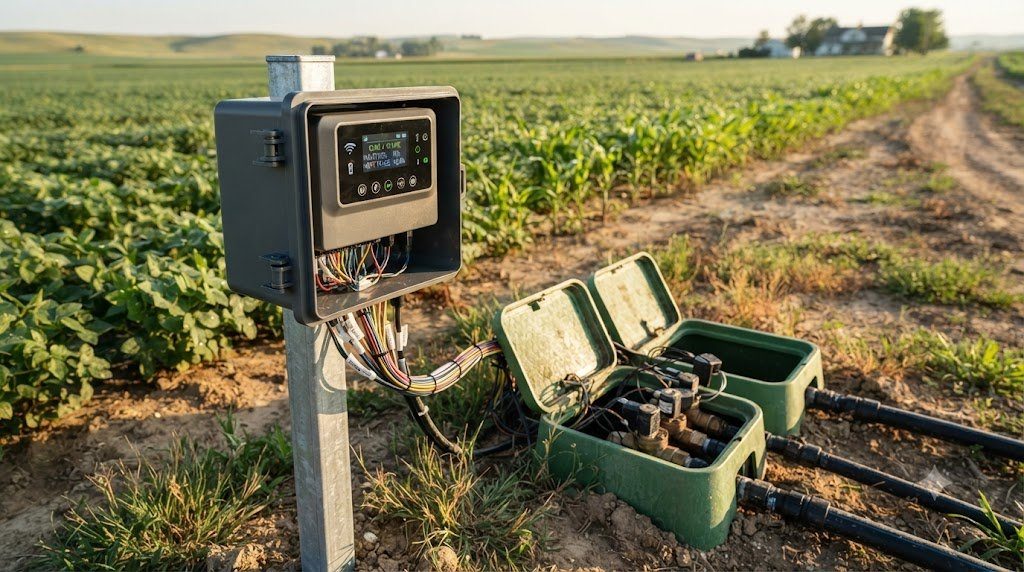
The digital revolution in agricultural water management has permanently replaced mechanical clock timers and manual hand-cranked valves with cloud-connected Internet of Things (IoT) smart controllers, localized on-farm weather stations, and automated hydraulic solenoids. Modern agricultural operations spanning thousands of hectares cannot afford the labor inefficiency, human error, and delayed response times inherent to manual valve operation. Smart IoT irrigation platforms synthesize real-time atmospheric sensor streams, soil moisture telemetry, hydraulic flow feedback, and satellite vegetation indices into automated, closed-loop irrigation scheduling.
However, transitioning to automated IoT control requires robust physical and electrical engineering. In rural agricultural zones subject to extreme lightning strikes, power surges, blowing dust, and intermittent cellular connectivity, fragile consumer-grade smart devices fail rapidly. Commercial agricultural automation demands industrial-grade programmable logic controllers (PLCs), 2-wire decoder communication protocols, long-range LoRaWAN telemetry radios, and fail-safe hydraulic master valve interlocks. This comprehensive technical guide details the hardware topologies, communication protocols, sensor integrations, and predictive algorithms required for industrial-scale smart irrigation automation.
The Closed-Loop Automation Paradigm
Open-loop automation runs on predetermined timers regardless of environmental conditions. Closed-loop IoT automation measures the physical outcome—sensing soil matric tension, real-time weather evapotranspiration, and ultrasonic flow verification—modulating valve opening durations dynamically until exact crop hydration targets are satisfied.
System Architecture: 2-Wire Decoder Networks vs Multi-Strand Wiring
Controlling dozens or hundreds of remote solenoid valves across sprawling commercial acreage presents a massive electrical wiring challenge. Traditional multi-strand wiring requires running a dedicated 24VAC copper wire from the central controller to every individual valve, plus a common ground wire. In a 50-valve system spanning two kilometers, multi-strand wiring requires tens of thousands of meters of copper wire, creating an expensive, lightning-vulnerable installation.
The 2-Wire Path Decoder Architecture
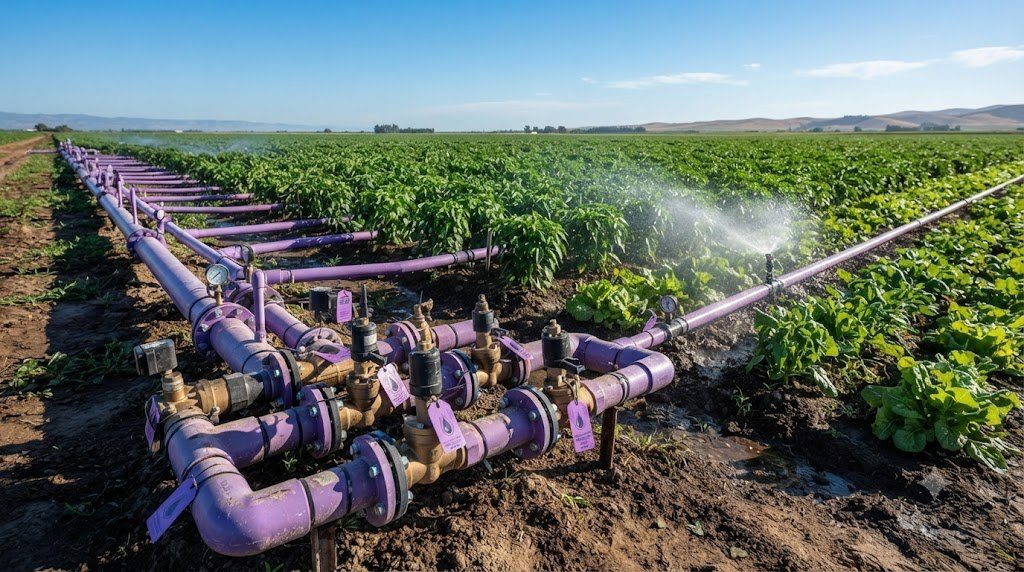
Modern commercial landscapes and agricultural systems utilize 2-wire path decoder technology. A single pair of heavy-gauge twisted-pair copper wires (typically 14 AWG direct-burial UF wire) runs in a continuous loop or branched spine across the entire property. The central controller transmits both continuous 24VAC operating power and high-frequency digital communication signals down the shared two-wire path simultaneously.
At each field valve, a compact hermetically sealed electronic decoder module is spliced into the two-wire path. Each decoder possesses a unique factory digital address. When the central controller wishes to activate Valve 27, it broadcasts a digital packet addressed specifically to Decoder 27 down the wire path. Decoder 27 recognizes its address and switches electrical power to its local solenoid, while all other decoders remain dormant. The two-wire path slashes copper wiring costs by up to eighty percent and allows new valves to be spliced into the existing wire path anywhere on the property without running new lines back to the controller.
Hydraulic Solenoid Valve Mechanics: Latching vs Continuous AC Pilots
The physical actuator converting electrical digital signals into fluid mechanical motion is the hydraulic solenoid valve. Agricultural automation utilizes two primary electromagnetic solenoid types:
1. Continuous 24VAC Solenoids
Standard 24-volt alternating current solenoids require continuous electrical current (typically 200 to 400 mA inrush, 150 to 250 mA holding current) to keep the internal plunger lifted against spring tension throughout the entire irrigation runtime. AC solenoids are robust and reliable on grid-powered installations. However, if power fails during an active cycle, the spring drops the plunger instantly, shutting the valve safely.
2. DC Latching Solenoids (Pulse Actuation)
In battery-powered or solar-powered off-grid wireless valve nodes, continuous power draw would drain batteries within days. DC latching solenoids utilize a permanent magnet and a reversible electromagnetic coil. To open the valve, the controller sends an ultra-fast 50-millisecond DC electrical pulse (+12V), snapping the plunger up where it remains magnetically locked in the open position with zero continuous power draw. To close the valve, the controller sends a reverse polarity pulse (-12V) that neutralizes the magnetic field, allowing the spring to push the plunger down. DC latching solenoids enable wireless valve nodes to operate for years on a single 9V alkaline battery.
On-Farm Weather Station Integration and Sensor Telemetry
A smart IoT controller achieves true predictive intelligence by interfacing with an on-site commercial meteorological station. Public regional weather forecasts are frequently measured at airports tens of kilometers away, failing to reflect localized farm micro-climates, temperature inversions, or localized cloud cover. An on-farm agricultural weather station measures six critical parameters:
- Solar Pyranometer: Measures incoming global solar irradiance (Watts/m²), the primary driving energy flux for soil evaporation and plant transpiration.
- Acoustic / Sonic Anemometer: Measures horizontal wind speed and direction with zero moving mechanical parts that could seize in dust storms.
- Digital Temperature and Relative Humidity Sensor: Encased in an aspirated radiation shield to prevent solar heating errors, calculating live Vapor Pressure Deficit (VPD).
- Tipping-Bucket Rain Gauge: Measures rainfall depth in 0.2 mm increments, providing immediate precipitation inputs to pause upcoming irrigation cycles.
- Barometric Pressure Sensor: Provides atmospheric pressure data for precise psychrometric equation solutions.
Automated Flow Monitoring and Leak Protection
Every smart IoT controller should integrate an ultrasonic or magnetic flow meter. The controller continuously compares live instantaneous flow readings against baseline zone profiles. If a pipe ruptures and flow spikes by 25% above normal, the controller automatically shuts down the master valve within 60 seconds and dispatches emergency SMS alerts, preventing water waste and road washouts.
Predictive Cloud Algorithms and Closed-Loop Feedback Control
Modern IoT irrigation platforms operate via cloud-based API architectures. The field controller transmits sensor data over cellular or LoRaWAN gateways to secure cloud servers, where machine learning algorithms calculate predictive water demand models:
- Predictive ET Forecasting: The algorithm pairs historical on-site ET data with 72-hour National Weather Service numerical weather prediction models. If an extreme heat wave is forecast for Thursday, the platform pre-irrigates root zones on Tuesday and Wednesday, building soil moisture reserves ahead of peak evaporative demand.
- Dynamic Soil Depletion Tracking: Continuous data from buried multi-depth capacitance probes feeds into the cloud algorithm. If light scattered rainfall moistened only the top 5 centimeters while the active taproot at 40 cm remains dry, the system calculates exact supplemental runtimes to rehydrate the lower root zone without over-saturating the surface.
- Pressure and Pump VFD Modulation: The cloud platform interfaces directly with pump station Variable Frequency Drives, modulating pump discharge pressure to deliver the exact dynamic head required for the specific zones actively running, eliminating throttling energy losses.
Frequently Asked Questions on Smart IoT Irrigation Controllers
Q: What happens to an IoT smart irrigation controller if the internet or cellular connection goes down?
Commercial agricultural IoT controllers feature edge computing firmware. All programmed schedules, sensor threshold rules, and safety parameters run locally on the internal microprocessor. If internet connectivity drops, the controller continues executing local schedules and safety shutdowns autonomously, synchronizing historical logs to the cloud once connectivity restores.
Q: How does lightning protection work on long 2-wire decoder paths?
Two-wire paths installed in open soil act as massive antennas for induced lightning surges. Install dedicated lightning surge arrestors (ground plates) every 150 to 200 meters along the wire path, connected to bare copper ground rods with earth resistance below 10 Ohms. Surges travel to ground safely rather than destroying connected decoders.
Q: Can a smart IoT controller detect a partially clogged filter bank?
Yes, by connecting differential pressure transducers upstream and downstream of the filter station to the controller’s analog inputs. When differential pressure exceeds calibrated thresholds (e.g., 0.6 bar), the controller triggers an automated hydraulic backwash sequence and records the event.
Q: What is LoRaWAN, and why is it preferred over Wi-Fi in agricultural fields?
LoRaWAN (Long Range Wide Area Network) operates on low-frequency radio waves (915 MHz in the Americas, 868 MHz in Europe) that penetrate dense crop canopies and travel 10 to 15 kilometers with line of sight. Wi-Fi operates at high frequencies (2.4/5 GHz) that cannot travel more than 100 meters in open fields.
Q: How do smart controllers prevent irrigation during high wind events?
Wind speeds exceeding 20 km/h severely distort sprinkler spray patterns. IoT controllers monitor real-time anemometer feeds; when wind exceeds an adjustable threshold (typically 15 to 25 km/h), the controller automatically suspends sprinkler cycles, rescheduling irrigation for calm nocturnal hours.
Q: Can existing manual hydraulic valves be retrofitted for automated IoT control?
Yes, manual valves can be retrofitted by replacing the manual bonnet bleed assembly with an electric solenoid pilot adapter, or by installing an inline motorized ball valve actuator, connecting directly to field decoder modules without excavating the valve body.
Radio Frequency (RF) Propagation and Fresnel Zone Engineering for LoRaWAN
Deploying long-range wireless sensor networks (LoRaWAN) across undulating farm acreage requires understanding electromagnetic radio wave propagation. While 915 MHz sub-gigahertz radio waves penetrate tree canopies significantly better than 2.4 GHz Wi-Fi, radio signals do not travel in a laser-thin line; they expand into an elliptical 3-dimensional volume known as the first Fresnel Zone.
The radius of the first Fresnel zone at the midpoint of a 5-kilometer telemetry link is calculated by r = 8.65 × √(d / f), where d is distance in km and f is frequency in GHz. For a 5 km link at 0.915 GHz, the Fresnel radius equals approximately 20.2 meters! If elevated hilltops, dense walnut canopies, or barn roofs penetrate more than 40% of this elliptical zone, radio signal attenuation (fade margin) increases dramatically, causing packet loss. Mounting central gateway antennas on 15-meter grain legs or communication masts ensures clear Fresnel clearance above mature orchard canopies.
Diagnostic Electrical Testing Protocols for 2-Wire Decoder Paths
When field decoders fail to respond on a commercial two-wire path, technicians follow a systematic diagnostic multimeter testing sequence:
- Loop Resistance Continuity Test: Disconnect the two wires at the controller and twist the distal end wires together in the field. Measure total loop electrical resistance with a digital ohmmeter. Standard 14 AWG direct-burial copper wire possesses approximately 8.5 Ohms of resistance per 1,000 meters of loop. Abnormal high resistance indicates a corroded splice or nicked wire.
- Insulation Resistance to Earth Ground (Megger Test): Using a 500V DC insulation tester (Megohmmeter), test resistance between each wire lead and a dedicated ground rod. A healthy direct-burial cable must measure above 10 Megohms of insulation resistance. Readings below 1 Megohm indicate damaged cable insulation contacting damp earth, which bleeds digital signaling packets into the soil.
- Milliamp Clamp Diagnostic: Clamp a high-precision digital mA meter around the wire path. Normal idle holding current equals approximately 0.5 to 1.0 mA per connected decoder. A sudden current spike above 50 mA indicates a shorted decoder solenoid.
Cybersecurity and fail-safe hardware watchdogs represent essential considerations in cloud-connected smart farm automation. If a cloud server experiences an outage or a cellular modem loses handshakes, agricultural IoT controllers must default to a secure local fail-safe state. Hardware watchdog timers monitor microprocessor activity; if firmware hangs, the watchdog resets the controller automatically within two seconds, restoring local schedule execution.
Additionally, all field valve solenoids must be interlocked with physical normally-closed hydraulic master valves. If a lightning strike or electronic glitch keeps an individual zone decoder energized, the master valve closes automatically at the conclusion of the scheduled runtime, preventing un-monitored continuous flooding that could drown crops and wash out rural farm access roads.