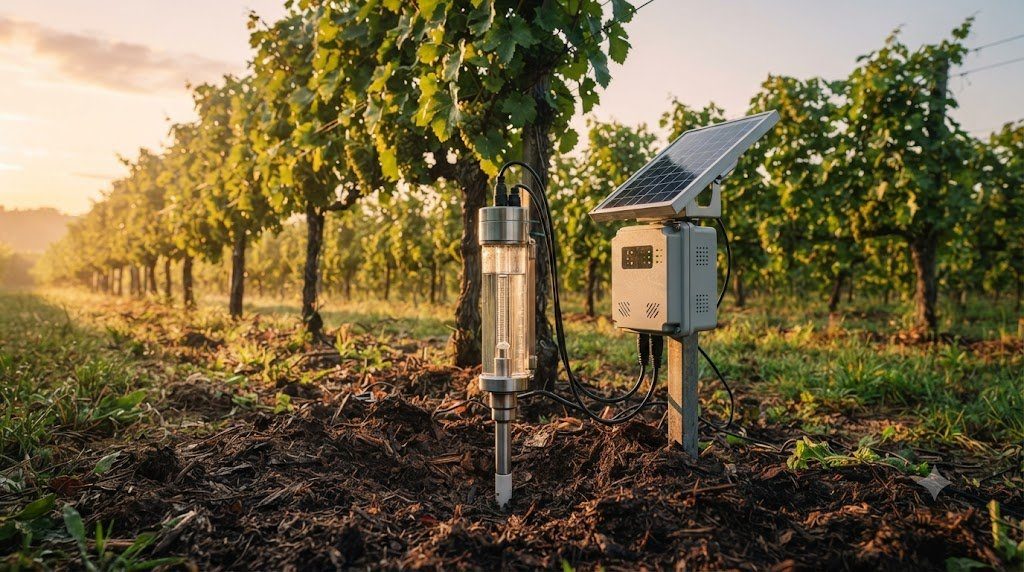
Precision irrigation planning represents the transition from intuition-based calendar watering to scientific, data-driven soil water management. Applying water on arbitrary days of the week regardless of actual plant consumption leads to either chronic over-watering—which leaches expensive nitrogen fertilizers into aquifers and suffocates root respiration—or unrecognized moisture stress that stunts vegetative growth and drastically lowers crop yield quality. Modern commercial irrigation management relies on combining real-time in-situ soil moisture monitoring telemetry with atmospheric Evapotranspiration (ET) water budgeting models to calculate the exact timing and volumetric depth of every irrigation set.
To master scientific irrigation scheduling, agronomists must understand both the physical energy status of soil water and the atmospheric evaporative demand driving crop transpiration. A sandy soil and a clay soil may hold identical volumes of water, yet the plant may thrive in the sand while suffering severe wilting stress in the clay due to differences in soil matric suction forces. By deploying continuous soil moisture profiling probes paired with on-site meteorological telemetry, farm managers can maintain soil moisture within the ideal Managed Allowable Depletion (MAD) envelope throughout critical crop phenological stages. This comprehensive technical guide details the physics of soil water tension, capacitance sensor mechanics, reference ET equations, and automated scheduling workflows.
The Volumetric vs Matric Distinction
Never confuse Volumetric Water Content (VWC %) with Soil Matric Potential (kPa / centibars). VWC measures the physical volume of water present in the soil. Matric Potential measures how tightly that water is bound to soil particles—which dictates how much physical suction energy plant roots must exert to extract it. Plants do not feel volume; plants feel tension.
Soil Water Physics: Saturation, Field Capacity, and Wilting Points
The retention and movement of water through the soil matrix is governed by capillary and adsorptive matric forces balanced against gravity. Soil moisture status is categorized into four classical thermodynamic states:
- Saturation (0 kPa / 0 bar): All soil pores—both micro-pores and macro-pores—are completely filled with water. Gravitational forces immediately begin draining water downward out of macro-pores. Prolonged saturation causes anaerobic conditions, root death, and denitrification.
- Field Capacity (-10 to -33 kPa): The moisture level reached after excess gravitational water has drained freely from the soil profile (typically 24 to 48 hours following heavy irrigation). Capillary suction holds water firmly within micro-pores against gravity. This represents the upper boundary of plant-available water.
- Management Allowable Depletion (MAD): The operational threshold (typically -50 to -80 kPa, or 30% to 50% depletion of available water) at which irrigation must be initiated to prevent crop physiological stress and stomatal closure.
- Permanent Wilting Point (-1,500 kPa / -15 bar): Soil particles hold remaining water films with such intense matric suction that plant root cells can no longer generate sufficient osmotic potential to extract water, resulting in irreversible vegetative wilting and plant death.
Sensor Instrumentation: Tensiometers, Granular Matrix, and Capacitance Probes
Selecting the appropriate in-situ sensor technology depends on whether the management strategy prioritizes soil matric potential or continuous volumetric moisture profiling:
1. Hydraulic Tensiometers and Pressure Transducers
Tensiometers measure the actual physical matric suction of soil water directly. A sealed water-filled tube features a porous ceramic cup buried at root depth. As the surrounding soil dries, capillary tension draws water out of the ceramic cup into the soil, creating a vacuum inside the sealed tube measured by a bourdon gauge or electronic pressure transducer. Tensiometers provide exceptional accuracy in the wet-to-moist range (0 to -80 kPa). However, if soil dries beyond -85 kPa, air enters the ceramic cup, breaking the vacuum column and requiring manual de-airing and refilling.
2. Granular Matrix Sensors (Watermark Sensors)
Granular matrix sensors utilize internal concentric electrodes encased in a synthetic porous matrix with a gypsum wafer buffer. As soil moisture fluctuates, the electrical resistance between the electrodes shifts in direct response to soil matric tension. Granular matrix sensors measure across an expansive range from -10 to -200 kPa, require zero seasonal refilling, and are completely immune to freeze-thaw damage, making them the most popular low-cost sensor for commercial row crop telemetry.
3. Frequency Domain Reflectometry (FDR) and Capacitance Multi-Depth Probes
Multi-depth capacitance probes consist of a sealed vertical tube containing multiple capacitive sensor rings spaced at 10-centimeter intervals (e.g., 10, 20, 30, 50, and 80 cm depths). The sensors generate a high-frequency electromagnetic field (typically 100 to 150 MHz) that extends through the access tube into the surrounding soil. Because the dielectric permittivity of water (≈ 80) is vastly greater than dry soil (≈ 4) or air (≈ 1), measuring electrical capacitance yields continuous real-time Volumetric Water Content data, revealing root water uptake patterns and deep percolation losses across distinct soil layers.
The Sensor Installation Imperative
A capacitance probe is only as accurate as its soil contact. Any air gaps, rock voids, or soil compaction channels created during slurry-less drill installation will distort the high-frequency electromagnetic field, rendering readings meaningless. Always utilize precision custom-tapered augers to achieve undisturbed root-soil contact along the entire probe length.
The Atmospheric Water Balance: FAO-56 Penman-Monteith ET Equations
While soil sensors measure root zone storage, atmospheric modeling calculates daily crop water depletion. The international standard for calculating reference crop evapotranspiration (ETo) is the FAO-56 Penman-Monteith equation, which synthesizes aerodynamic and thermodynamic energy fluxes:
Where:
• R_n = Net radiation at the crop surface (MJ/m²/day)
• G = Soil heat flux density (MJ/m²/day)
• T = Mean daily air temperature at 2 m height (°C)
• u_2 = Wind speed at 2 m height (m/s)
• (e_s – e_a) = Saturation vapor pressure deficit (kPa)
• Δ = Slope of vapor pressure curve (kPa/°C)
• γ = Psychrometric constant (kPa/°C)
Once daily reference ETo is derived from an on-farm weather station, actual daily crop evapotranspiration (ETc) is calculated by multiplying ETo by the crop-specific growth stage coefficient (Kc):
ET_c = ET_o × K_c
Crop coefficients fluctuate dramatically across the growing season. An almond orchard in early spring bud break exhibits a Kc of 0.40; during mid-summer kernel fill, Kc surges to 1.15; during post-harvest senescence, Kc declines back to 0.65. Multiplying ETo by dynamic Kc values provides the daily millimeter water depth that must be replenished by irrigation.
The Checkbook Water Budgeting Accounting Workflow
Commercial irrigation managers synthesize sensor data and ET modeling through the ‘Checkbook Method’ of soil moisture accounting. The root zone is treated as a financial bank account:
- Starting Balance (Deposits): Field capacity represents the maximum credit balance. Effective rainfall (precipitation exceeding 5 mm that infiltrates the soil) and irrigation applications represent positive credit deposits.
- Daily Debits: Daily crop evapotranspiration (ETc) represents a continuous debit withdrawal from the soil account.
- Withdrawal Limit (MAD): When cumulative daily withdrawals reduce the soil balance down to the predetermined Management Allowable Depletion limit (e.g., 45 mm of available water depleted), an irrigation event is triggered.
- Irrigation Runtime Calculation: The required runtime (hours) equals the net depth to replenish divided by the application rate of the irrigation system: Runtime = (Depleted_mm / Application_Rate_mm_hr) / System_Efficiency.
Frequently Asked Questions on Soil Moisture and ET Scheduling
Q: What is the difference between total soil water and plant-available water?
Total soil water encompasses all water molecules within the soil, including hygroscopic water bound so tightly to clay platelets that plants cannot extract it. Plant-Available Water (PAW) is exclusively the fraction held between Field Capacity (-10 to -33 kPa) and Permanent Wilting Point (-1,500 kPa).
Q: How many soil moisture sensor stations are required per commercial agricultural field?
As a baseline, deploy at least one representative monitoring station per uniform soil management zone (typically one station every 15 to 30 hectares in broadacre, or one per 5 to 10 hectares in high-value specialty orchards). If a single field contains both sand ridges and heavy clay basins, each soil texture must have an independent sensor station.
Q: Why does my soil moisture probe show a sharp moisture spike at the 80 cm depth after a light irrigation?
A moisture spike beneath the active root zone following irrigation indicates deep percolation loss—meaning you applied more water than the upper soil profile could hold, causing water to drain downward past the roots. This indicates an over-watering condition that wastes pumping energy and leaches mobile nitrate fertilizers.
Q: Can satellite NDVI vegetation imagery replace ground-based soil moisture sensors?
No, satellite imagery (NDVI/thermal) provides excellent spatial mapping of crop canopy vigor and transpiration stress across entire fields, but it detects stress only after the plant has already suffered cellular dehydration. In-situ soil moisture sensors provide preventative early warning days before moisture deficits manifest visibly in satellite scans.
Q: How does salinity affect electrical soil moisture sensor readings?
High soil salinity (elevated electrical conductivity) increases electrical conductance, causing electromagnetic capacitance and TDR sensors to overestimate soil moisture content. Advanced capacitance probes incorporate high-frequency circuitry (above 100 MHz) and temperature-corrected salinity compensation algorithms to eliminate electrical conductivity interference.
Q: What is the recommended soil matric potential threshold for irrigating wine grapes?
Wine grape viticulture frequently utilizes Regulated Deficit Irrigation (RDI) to control vegetative canopy vigor and concentrate phenolic flavors. Soil matric tension is maintained between -60 and -100 kPa during early fruit set, dropping to moderate stress (-150 to -250 kPa) between berry veraison and harvest.
Soil Water Retention Curves and the Van Genuchten Mathematical Model
The relationship between soil matric suction (ψ) and volumetric moisture content (θ) is non-linear and governed by the soil water characteristic retention curve. Agricultural soil scientists model this dynamic behavior using the empirical Van Genuchten equation:
Where:
• Θ = Normalized relative soil water saturation [(θ – θ_r) / (θ_s – θ_r)]
• θ_s = Saturated volumetric water content (m³/m³)
• θ_r = Residual residual water content held tightly against root extraction
• α, n, m = Empirical soil pore size and pore distribution parameters (m = 1 – 1/n)
In fine-textured silty clay loams, the retention curve exhibits a gradual, gentle slope, indicating that soil releases water progressively across a broad suction range from -30 to -200 kPa. In coarse sands, however, the curve drops precipitously between -10 and -30 kPa; once sand dries past -25 kPa, nearly all available capillary water is exhausted, causing rapid crop wilting if irrigation is not initiated immediately.
Practical Field Protocols for Tensiometer Priming and Winter Storage
Maintaining high measurement precision with hydraulic tensiometers requires strict maintenance adherence:
- De-Aired Water Preparation: Always fill tensiometer tubes with freshly boiled or distilled de-aired water treated with a non-toxic algaecide (such as copper sulfate). Standard tap water contains microscopic dissolved air bubbles that expand under vacuum, creating false low-tension readings.
- Hand Vacuum Pump De-Airing: Following installation, apply a manual vacuum pump with a rubber stopper to the tensiometer top reservoir, pulling a 70 kPa vacuum for 2 minutes to extract trapped air bubbles from the porous ceramic tip pores.
- Frost Extraction and Storage: In freezing climates, tensiometers must be excavated from the field before the first ground freeze. Freezing water inside the ceramic cup will expand and crack the porous matrix. Store units upright in a frost-free shop with ceramic cups submerged in distilled water.
Integrating real-time soil moisture telemetry with satellite-derived NDVI (Normalized Difference Vegetation Index) maps creates a multi-layered precision agronomy platform. While satellite imagery provides macro-scale spatial resolution showing canopy uniformity across hundreds of hectares, in-situ soil capacitance probes provide micro-scale temporal resolution measuring exact root extraction depth minute by minute. Combining both data layers enables farm managers to pinpoint irrigation under-performance caused by clogged valves or emitter blockages days before visible foliar stress manifests across the field.