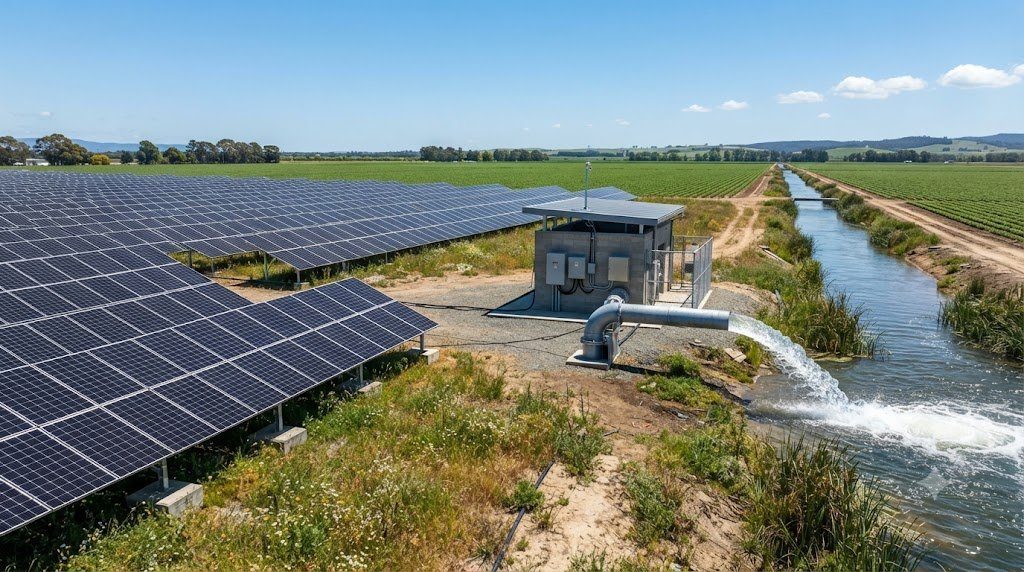
Solar photovoltaic (PV) water pumping represents a transformative technological leap for global agriculture, decoupling irrigation water delivery from fossil fuel volatility and rural electrical grid instability. In remote pastoral grazing lands, off-grid horticulture developments, and developing agrarian regions where utility grid extensions cost tens of thousands of dollars per kilometer, solar irrigation systems provide reliable, zero-emission water conveyance. However, because solar energy intensity fluctuates continuously throughout the diurnal cycle from early morning dawn to noon peak irradiance, engineering a solar pump requires sophisticated matching of PV array sizing, Variable Frequency Drive (VFD) maximum power point tracking (MPPT), and hydraulic storage buffers.
The primary engineering distinction between grid-powered pumping and solar pumping lies in the dynamic nature of the power source. A standard utility motor operates at constant voltage and frequency (e.g., 480V at 60 Hz). A solar-powered pump operates on variable direct current (DC) converted into variable-frequency alternating current (AC). When a cloud passes over the photovoltaic array, available power drops instantly; the system controller must rapidly modulate motor frequency and impeller RPM to prevent the pump from stalling while maintaining sufficient head to overcome static well lift. This comprehensive technical guide details the sizing formulas, solar insolation physics, MPPT tracking algorithms, and battery-less hydraulic storage architectures essential for off-grid solar irrigation.
The Battery-Less Hydraulic Storage Axiom
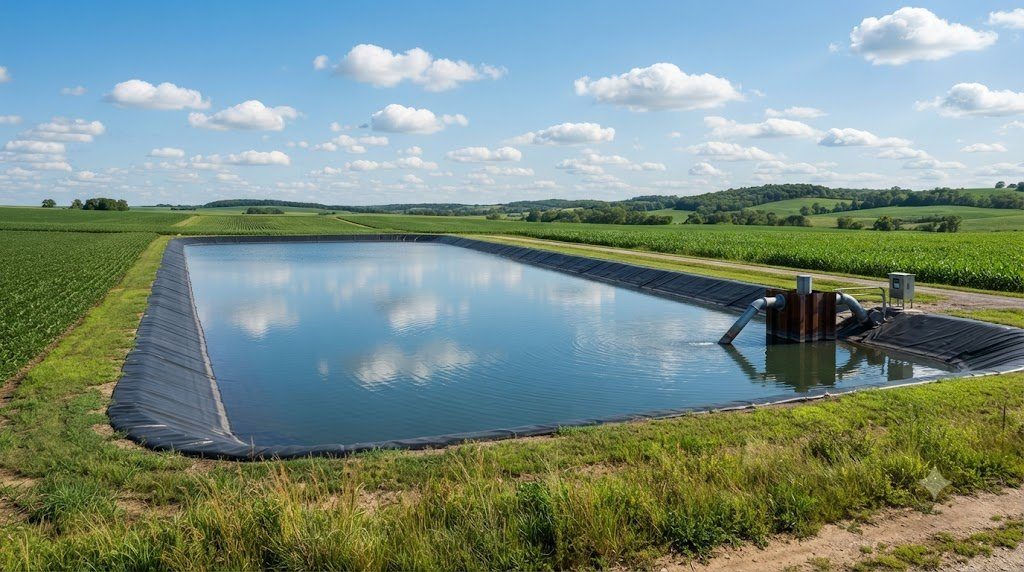
Modern agricultural solar pumping systems deliberately eliminate chemical battery banks. Storing energy electrochemically in lead-acid or lithium batteries adds massive capital cost, requires continuous maintenance, and suffers from short lifespan in harsh desert temperatures. Instead, engineers utilize ‘hydraulic storage’—pumping surplus water during peak solar hours directly into elevated reservoirs or holding ponds, gravity-feeding irrigation lines when the sun sets.
Photovoltaic Array Sizing: Solar Insolation and Peak Sun Hours
Designing an agricultural solar pump begins with quantifying the local solar resource. Solar irradiance is measured in Watts per square meter (W/m²), while daily cumulative solar energy is quantified in Peak Sun Hours (PSH). One Peak Sun Hour represents the equivalent cumulative solar radiation received at a standardized intensity of 1,000 W/m² over a one-hour window:
To determine the total daily volume of water required (V_daily in cubic meters), agricultural planners multiply the crop acreage by the peak daily evapotranspiration rate (ETc in mm/day) and divide by system application efficiency. For example, a 5-hectare orchard with a peak mid-summer ETc of 6.0 mm/day requires:
V_daily = (5 ha × 6.0 mm × 10) / 0.90 = 333.3 m³/day
If local meteorological data indicates an average design-month solar insolation of 5.5 Peak Sun Hours, the solar pump must deliver this total daily volume within the equivalent window, establishing the required nominal system flow rate: Q_hourly = 333.3 m³ / 5.5 hours = 60.6 m³/hr (approximately 16.8 L/s).
Calculating Required PV Array Peak Wattage (W_p)
To calculate the required photovoltaic array capacity in peak Watts (Wp), engineers combine the hydraulic energy equation with system de-rating factors:
E_hydraulic (Watt-hours/day) = ( ρ × g × V_daily × TDH ) / 3,600
P_array (Watts_peak) = E_hydraulic / ( PSH × η_pump × η_motor × η_controller × DF )
Where ρ is water density (1,000 kg/m³), g is gravity (9.81 m/s²), TDH is Total Dynamic Head in meters, and DF is the combined environmental de-rating factor (typically 0.75 to 0.82) accounting for module soiling, dust accumulation, high ambient temperature losses (temperature coefficient of Pmax), and wiring voltage drop.
Solar VFD Architecture: MPPT Algorithms and Frequency Modulation
The technical core of an off-grid AC solar pump installation is the Solar Variable Frequency Drive. Standard industrial VFDs designed for utility grid AC power cannot operate directly on fluctuating DC solar inputs. A dedicated solar VFD integrates specialized Maximum Power Point Tracking (MPPT) firmware:
The Maximum Power Point Tracking (MPPT) Mechanism
A solar photovoltaic module exhibits a non-linear current-voltage (I-V) curve. There exists a single unique operating point on the curve where the product of voltage and current (Power = V × I) reaches its absolute maximum (Pmp). As sunlight intensity changes or solar panels heat up under desert sun, this maximum power point shifts continuously. The solar VFD utilizes advanced algorithms (such as ‘Perturb and Observe’ or ‘Incremental Conductance’) to adjust its DC bus voltage thousands of times per second, ensuring the PV array always extracts 100% of available solar wattage.
Dynamic Frequency Modulation Across Diurnal Cycles
Unlike grid pumps running at fixed 50 Hz or 60 Hz, the solar VFD dynamically adjusts motor output frequency between 25 Hz and 60 Hz in response to available DC wattage. During early morning hours (low irradiance), the drive runs the motor at 30 Hz. As midday sun peaks, frequency ramps smoothly to 50 Hz or 60 Hz. The drive firmware incorporates a critical ‘Minimum Frequency Cutoff’ (typically 30 Hz). If available solar power drops so low that the pump cannot generate sufficient head to lift water to the surface, the drive puts the motor into sleep mode, preventing idle spinning that causes motor overheating without water flow.
The VFD Thermal Warning
Solar VFDs generate substantial internal heat via their insulated-gate bipolar transistors (IGBTs). In agricultural field installations where ambient summer temperatures exceed 45°C (113°F), VFD enclosures must be mounted under shaded ventilated canopies or equipped with thermostatically controlled cooling fans. Never mount a solar drive in direct un-shaded sunlight.
PV Array Ground Mounting: Fixed Tilt vs Single-Axis Trackers
Selecting the structural racking topology for agricultural solar arrays impacts total daily water yield and capital economics:
- Fixed-Tilt Ground Mounts: Panels are bolted to galvanized steel piles at a fixed tilt angle equal to local latitude (or optimized for summer irrigation months: latitude minus 10 to 15 degrees). Fixed mounts feature zero moving parts, withstand 150 km/h wind gusts, and require zero mechanical maintenance. Water delivery peaks sharply at solar noon in a bell-shaped curve.
- Single-Axis Active Trackers: Panels rotate from east to west on a motorized horizontal axis, following the sun’s trajectory across the sky. Single-axis tracking extends peak pumping hours by 25% to 35%, flattening the daily delivery curve into a wide, uniform plateau. This extended run time allows designers to specify a smaller pump and narrower distribution pipes to achieve identical daily water volumes.
Grounding, Lightning Protection, and High-Voltage DC Safety
Solar pumping arrays operate at high DC voltages, typically ranging from 400V to 800V DC across series module strings. Direct current arcs are self-sustaining and do not self-extinguish like AC arcs, creating severe fire and electrocution hazards if safety codes are neglected:
- DC-Rated Rotary Disconnect Switches: Always install dedicated lockable DC disconnect switches rated for maximum string open-circuit voltage (Voc) and short-circuit current (Isc). Never use standard AC circuit breakers on high-voltage DC lines.
- Surge Protection Devices (SPDs): Solar arrays installed in open agricultural fields act as prime lightning attractors. Install Class II DC surge arrestors at the combiner box and VFD input terminals to divert induced voltage spikes into ground rods.
- Equipotential Earth Grounding: Bond all solar panel aluminum frames, structural steel racking, pipe casings, and drive enclosures to a dedicated grounding electrode system with soil resistance below 5 Ohms.
Frequently Asked Questions on Solar Irrigation Pumps
Q: Can a solar-powered irrigation pump operate directly with pressurized drip systems?
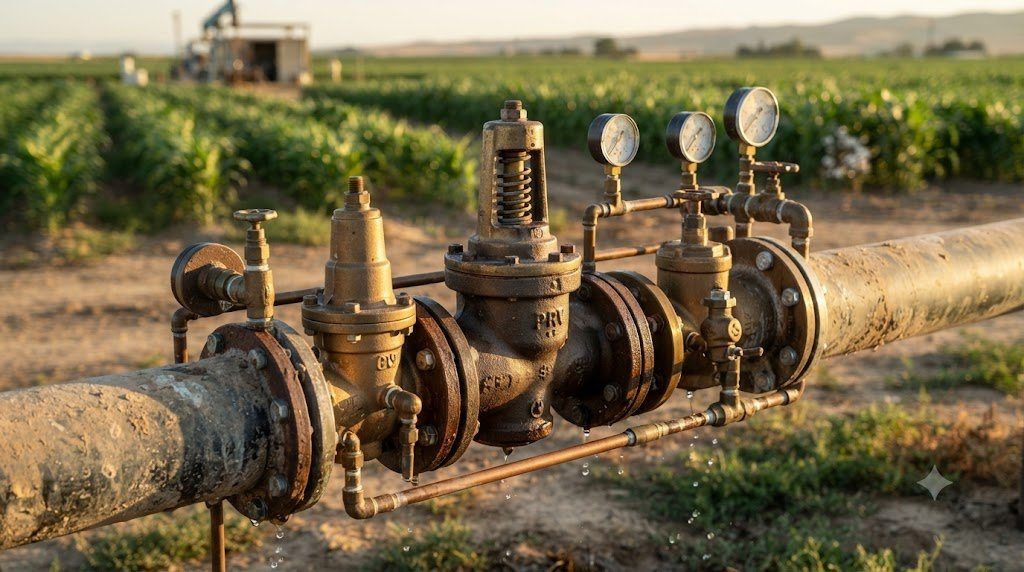
Yes, but it requires a pressure-sustaining bypass valve or elevated storage buffer. Because solar pump flow and pressure fluctuate throughout the day as sunlight varies, connecting a solar pump directly to fixed-orifice emitters causes emitter pressure to drop during cloud cover. The best engineering practice is pumping to an elevated reservoir that gravity-feeds the drip network at constant pressure.
Q: What is the typical operational lifespan of a solar pumping system?
Tier-1 monocrystalline solar PV panels feature manufacturer performance warranties of 25 to 30 years, degrading at less than 0.5% per year. Solar Variable Frequency Drives have an expected service life of 8 to 12 years (with periodic cooling fan replacements). High-grade stainless steel submersible pumps operate for 10 to 15 years in non-abrasive water.
Q: How do solar pumps handle dusty, dusty desert environments where panels get dirty?
Dust, pollen, and bird droppings (soiling) reduce solar energy output by 15% to 30% if left uncleaned. In commercial farm setups, operators utilize surplus morning water from the system to wash panel glass weekly, or install automated micro-spray panel wash nozzles programmed to rinse modules at dawn.
Q: Can a solar pump switch automatically to a backup diesel generator or grid power during cloudy weeks?
Yes, modern solar VFDs feature dual-input hybrid terminals. An automated transfer switch (ATS) detects when solar DC bus voltage drops below operational thresholds for more than 15 minutes, automatically starting an auxiliary diesel generator or switching to grid power to ensure critical crops never suffer moisture stress.
Q: Why are helical rotor (positive displacement) pumps used in low-power solar systems?
Helical rotor pumps maintain high operating head even at low motor speeds and low solar wattage. Unlike centrifugal impellers that lose head rapidly when RPM drops (Affinity Law 2), a positive displacement pump continues pushing water up deep well columns during early dawn and late dusk, extracting maximum daily volume from small 500W to 2000W PV arrays.
Q: Is a solar irrigation system economically viable compared to grid electricity?
If 3-phase utility grid power is already present at the wellhead, grid power is often cheaper in upfront capital expenditure. However, if utility line extension is required (costing $15,000 to $40,000 per mile), or if diesel fuel logistics are expensive, solar pumping achieves full capital payback within 2 to 4 years and delivers free water for the subsequent two decades.
Bifacial Photovoltaic Modules in Agricultural Agrivoltaic Systems
The integration of bifacial photovoltaic modules represents the latest evolution in agricultural solar pumping engineering. Unlike standard monofacial panels that generate electricity exclusively from direct sunlight striking their top face, bifacial panels feature transparent glass backings that absorb reflected albedo solar radiation from the ground beneath the array.
In agricultural installations where arrays are mounted over light-colored sandy soils, dry gravel, or light green pasture grasses, rear-side solar absorption delivers an additional 12% to 25% energy gain (bifacial boost). This surplus energy significantly extends morning and evening pumping hours, enabling the solar pump to maintain required head pressure earlier at dawn and later into dusk without expanding the system’s structural footprint.
In agrivoltaic dual-use layouts, solar panels are elevated 2.5 to 3.5 meters above ground on sturdy steel pylons. This configuration allows shade-tolerant specialty crops, sheep grazing, or drip-irrigated vegetable beds to flourish directly beneath the solar array. The micro-climate created beneath the panels reduces soil moisture evaporation by up to thirty percent, while plant transpiration cools the underside of the solar modules, improving photovoltaic electrical conversion efficiency during scorching summer afternoons.